
Neonympha mitchellii
French, 1889
Mitchell's Satyr, Mitchell's Marsh Satyr, Saint Francis' Satyr
Neonympha mitchellii is a federally endangered nymphalid of the eastern United States. The comprises two recognized : N. m. mitchellii (Mitchell's satyr) in Michigan and Indiana, and N. m. francisci (Saint Francis' satyr) restricted to a single metapopulation at Fort Bragg, North Carolina. Additional discovered in Alabama, Mississippi, and Virginia since 1998 remain under taxonomic study. All populations are protected under the Act.


Pronunciation
How to pronounce Neonympha mitchellii: //niː.oʊˈnɪm.fə mɪˈtʃɛl.i.aɪ//
These audio files are automatically generated. While they are not always 100% accurate, they are a good starting point.
Identification
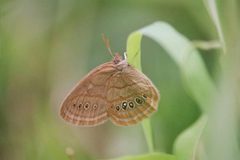
Distinguished from similar satyr butterflies by the combination of small size (34–44 mm wingspan), uniformly brown unmarked upper wing surfaces, and rows of round yellow-ringed eyespots on wing undersides. N. m. francisci differs from N. m. mitchellii in being slightly darker with more irregularly shaped eyespots. The Carolina satyr (Hermeuptychia sosybius) is similar in appearance but is a separate ; precise field identification may require close examination of wing pattern details.
Images
Appearance
Small brown with wingspan 34–44 mm. Upper wing surfaces unmarked. Undersides of wings display rows of round, yellow-ringed eyespots. N. m. francisci is slightly darker with more irregularly shaped eyespots. greenish white to cream, darkening to tan with age. First instar larvae 3–4 mm long with dark brown bilobed ; subsequent instars 6–12 mm long with green bilobed heads, green bodies, and raised white lateral ridges. Chrysalis 10.5–15.5 mm long, light lime green with pale green or white speckling, suspended head-down; turns medium brown two days before .
Habitat
Wetland including prairie fens with alkaline, saturated soils, emergent vegetation, and scattered shrubs. N. m. mitchellii occurs in Michigan prairie fen . N. m. francisci inhabits a restricted area within Fort Bragg, North Carolina.
Distribution
Eastern United States. N. m. mitchellii: Michigan and Indiana; presumably extirpated from Ohio (last observed 1950s), New Jersey (last observed 1988), and Wisconsin. N. m. francisci: single metapopulation within a 10 × 10 km area at Fort Bragg, North Carolina. Additional discovered since 1998 in Alabama, Mississippi, and Virginia remain under taxonomic study.
Diet
Larvae feed on Japanese stilt grass (Microstegium vimineum), a highly plant .
Host Associations
- Microstegium vimineum - larval plantJapanese stilt grass;
Life Cycle
hatch after greenish white to cream eggs darken to tan. First instar larvae 3–4 mm with dark brown bilobed . Four subsequent instars 6–12 mm with green bilobed heads and green bodies with raised white lateral ridges. Chrysalis 10.5–15.5 mm long, suspended head-down, light lime green with pale speckling, turning medium brown two days before .
Human Relevance
Federally protected under the Endangered Species Act. Subject of landscape conservation research examining corridors and restoration effects on viability. Populations potentially at risk from control efforts targeting the Japanese stilt grass, which serves as a larval plant.
Similar Taxa
- Hermeuptychia sosybiusSimilar appearance as a small brown satyr ; both can feed on Microstegium vimineum, but H. sosybius is a distinct species requiring close examination for differentiation
More Details
Conservation Status
All , including newly discovered , are federally protected under the Act. N. m. francisci is restricted to one of the smallest known ranges for any North American .
Taxonomic Uncertainty
discovered in Alabama, Mississippi, and Virginia since 1998 are under study and may be classified with N. m. mitchellii or described as new .
Sources and further reading
- BugGuide
- Wikipedia
- GBIF taxonomy match
- iNaturalist taxon
- NCBI Taxonomy
- Landscape Conservation for Rare Insects | Bug Squad
- Habitat Use by the Federally Endangered Mitchell's Satyr Butterfly (Neonympha mitchellii mitchellii) in a Michigan Prairie Fen
- Distribution, Population Structure and Habitat Use of the Endangered Saint Francis Satyr Butterfly, Neonympha Mitchellii Francisci