
Lethe portlandia
(Fabricius, 1781)
Southern Pearly-eye, Portland Pearlyeye, Pearly Eye
Lethe portlandia, commonly known as the Southern Pearly-, is a satyrine in the Nymphalidae. The is to the southeastern United States, ranging from eastern Oklahoma and Texas eastward through the coastal plain. are characterized by eyespots on the wings and a distinctive pattern in shaded woodland . The species has been subject to taxonomic revision, with some authorities placing it in the Enodia.
Pronunciation
How to pronounce Lethe portlandia: /ˈlɛθ.i pɔːrtˈlæn.di.ə/
These audio files are automatically generated. While they are not always 100% accurate, they are a good starting point.
Identification
Distinguished from by geographic range and wing pattern details. Lethe anthedon (Northern Pearly-eye) overlaps partially in range but has more rounded hindwing eyespots with more complete dark rings. Lethe appalachia (Appalachian Brown) occurs in more northern and montane . L. portlandia typically shows larger, more diffuse eyespots with broken dark rings on the hindwing. is slow and bouncing, usually within 2 meters of the forest floor.
Images
Appearance
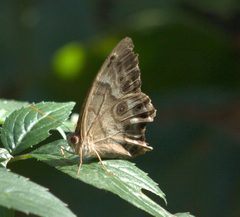
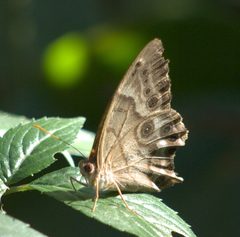
Medium-sized with wingspan approximately 45-55 mm. wing surfaces are brown with darker margins. surfaces display the characteristic "pearly" eyespots—pale-centered ocelli ringed with darker —typically two per hindwing and one per forewing. are clubbed with pale tips. Wing margins are somewhat angular, particularly on the hindwing.
Habitat
Deciduous woodlands and forest edges, particularly in bottomlands and riparian corridors. Strongly associated with shaded environments containing cane (Arundinaria) and other understory vegetation. Occurs in both mature forests and regenerating stands with adequate cover.
Distribution
Southeastern United States: eastern Oklahoma, eastern Texas, Louisiana, Arkansas, Mississippi, Alabama, Georgia, Florida, South Carolina, North Carolina, and Virginia. Primarily confined to the Atlantic and Gulf Coastal Plains with limited extension into the Piedmont.
Seasonality
are active from late spring through summer, with peak typically June-August. Single brooded throughout most of range; partial second has been suggested in the southernmost but is not well documented.
Diet
Larvae feed on cane (Arundinaria gigantea and related bamboos). have been observed feeding on sap flows, rotting fruit, and animal droppings; flower visitation is rare.
Host Associations
- Arundinaria gigantea - larval plantNative bamboo; primary throughout range
Life Cycle
are laid singly on or near plant stems. Larvae feed on cane leaves, resting in shelters constructed by tying leaf edges together. occurs in leaf litter or loose soil at base of host plant. Overwinters as larva; development resumes in spring. Total development time from egg to is approximately 6-8 weeks under favorable conditions.
Behavior
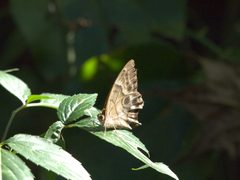
are and shade-tolerant, rarely flying in full sun. When disturbed, they typically fly short distances and settle on tree trunks or leaf undersides with wings closed, relying on cryptic coloration. Males perch on low vegetation to await females. Both sexes frequently rest with oriented downward.
Ecological Role
Larval stage functions as a herbivore on native bamboos, with limited impact on plant due to low . serve as minor and contribute to nutrient cycling through sap-feeding and carrion visitation. Prey item for birds, spiders, and other .
Human Relevance
No significant economic impact. Occasionally encountered by hikers and naturalists in southeastern woodlands. Sensitive to fragmentation and canebrake degradation. Used as an for intact bottomland forest in some conservation assessments.
Similar Taxa
- Lethe anthedonNorthern Pearly-eye; distinguished by more northern distribution, more rounded and complete eyespot rings, and preference for cooler, more mesic forests
- Lethe appalachiaAppalachian Brown; occurs at higher elevations, has smaller eyespots with more prominent dark centers, and lacks the diffuse pearly quality of L. portlandia eyespots
- Lethe creolaCreole Pearly-eye; restricted to Gulf Coast, has more uniformly brown wing surface with reduced eyespot contrast
More Details
Taxonomic history
Long treated as Enodia portlandia, but recent molecular and morphological studies support placement in Lethe. The Enodia is now restricted to a smaller clade of primarily northern . This revision reflects improved understanding of satyrine rather than new biological data.
Conservation status
Not formally listed as threatened, but canebrake have declined substantially due to agriculture, fire suppression, and hydrological alteration. trends are poorly monitored; local extirpations have been documented in fragmented landscapes.