
Lethe anthedon
(A. Clark, 1936)
Northern Pearly-eye
Lethe anthedon, the northern pearly-, is a in the Nymphalidae, Satyrinae. It is found in eastern North America from central Saskatchewan and Nebraska east to Nova Scotia, south to central Alabama and Mississippi. The inhabits riparian forests and moist woodland edges where larvae feed on grasses and forage for nutrients at sap flows and animal .
Pronunciation
How to pronounce Lethe anthedon: /ˈlɛθ.i ænˈθiː.dɒn/
These audio files are automatically generated. While they are not always 100% accurate, they are a good starting point.
Identification
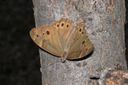
Distinguished from similar Satyrodes (Appalachian brown and eyed brown) by geographic range and subtle wing pattern differences. The northern pearly- occupies more northerly and westerly areas than the Appalachian brown. Eyed brown prefers wetter and has more prominent eyespots. Pearly eyespots on the underside are distinctive when the is at rest with wings closed.
Images
Appearance
Wingspan 43–67 mm (1.5–2.5 inches). Upperside brown with dark eyespots. Underside brown with pearly, iridescent eyespots that give the its .
Habitat
Riparian forests, moist woodland edges, and forest glens near creeks, ponds, and slow-moving streams. Associated with grassy understory vegetation including cutgrass and bottlebrush grass.
Distribution
North America: central Saskatchewan and eastern Nebraska east to Nova Scotia, south to central Alabama and Mississippi. Present in Alberta, Manitoba, and Saskatchewan in Canada.
Seasonality
active in summer. overwinters in the larval stage.
Diet
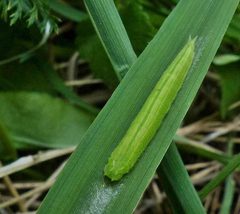
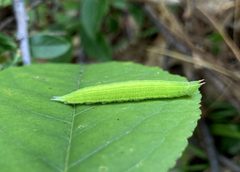
Larvae feed on various grasses including Leersia virginica, Erianthus , Muhlenbergia species, Brachyelytrum erectum, Chasmanthium latifolium, Hystrix patula, and Schizachne purpurascens. Northern also use sedges (Carex species). feed on , fungi, carrion, and sap from willows, poplars, and birches.
Host Associations
- Leersia virginica - larval food plant
- Carex species - larval food plantnorthern
- Salix species - food sourcesap
- Populus species - food sourcesap
- Betula species - food sourcesap
Life Cycle
Overwinters as larva. Complete with , larva, pupa, and stages.
Behavior
cruise forest glens searching for sap-fluxes on trees and deposits of animal to harvest proteins and for development and energy. Rest on vegetation and tree trunks with wings closed, showing pearly eyespots. Adults are preyed upon by aerial hunters including clubtail (Gomphidae), particularly when in .
Ecological Role
Larval herbivore on native grasses. nutrient recycler through consumption of , carrion, and fungal material. Prey item for and other aerial .
Human Relevance
No significant direct human impact. Subject of ecological study and watching. MONA/Hodges number 4568.1.
Similar Taxa
- Satyrodes appalachiaAppalachian brown; similar appearance but restricted to Appalachian region, prefers wetter
- Satyrodes eurydiceEyed brown; more prominent eyespots, different preferences and range
More Details
Predation
are vulnerable to by clubtail (Gomphidae), which capture them in using spined legs held basket-like beneath the body. Hagenius brevistylus, the dragonhunter, is a particularly aggressive known to take butterflies including the northern pearly-.
Subspecies
Two recognized: Lethe anthedon anthedon and Lethe anthedon borealis, both described by A. Clark in 1936.