
Anartia fatima
Fabricius, 1793
Banded Peacock, Fatima
Anartia fatima, the banded peacock, is a in the Nymphalidae. It occurs from southern Texas through Mexico and Central America to Panama, inhabiting subtropical open areas and disturbed such as second-growth woodlands. Males defend territories around plants to secure mating opportunities, a documented in both this and its Anartia jatrophae. The species exhibits wing color , with individuals bearing either white or yellow bands.
Pronunciation
How to pronounce Anartia fatima: /əˈnɑːrtiə ˈfætɪmə/
These audio files are automatically generated. While they are not always 100% accurate, they are a good starting point.
Identification
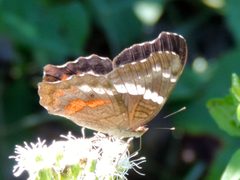
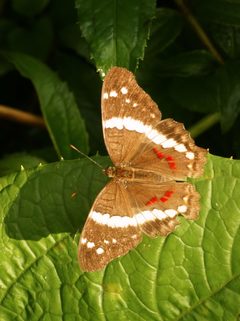
Distinguished from Anartia jatrophae (white peacock) by the prominent light band across both wing pairs, versus the spotted pattern of A. jatrophae. The banded pattern separates it from other Anartia . Within its range, the combination of dark brown wings with contrasting white or yellow bands and red basal hindwing spots is diagnostic. Similar to A. amathea in South America, but ranges do not overlap; A. amathea replaces A. fatima south of Panama.
Images
Appearance
have dark brown wings with a bold, contrasting light-colored band running across both forewings and hindwings. Four to five red spots of varying sizes mark the basal portion of the hindwing. Seven small spots appear near the apex and post-median area of the forewing. Wing color exists: some individuals display white bands, others yellow bands. Females tend to have more diffusely edged pattern elements than males. Wingspan is moderate for the .
Habitat
Occupies subtropical open areas and previously disturbed places, including second-growth woodlands and forest edges. Found from sea level to 1,500 meters elevation. Occurs in moist areas, particularly near rivers and in swampy meadows where larval plants grow. Prefers with abundant Acanthaceae vegetation.
Distribution
North America: southern Texas (regular), occasionally as far north as Kansas (rare). Mexico: widespread. Central America: Guatemala, Belize, Honduras, El Salvador, Nicaragua, Rica, Panama. Absent from South America, where replaced by Anartia amathea. Ubiquitous throughout its documented range.
Seasonality
Active year-round in most of its range. In Rica, dry season movements occur along the Pacific coast. fly from late morning through early afternoon; males emerge earlier than females. Migratory to South Texas occur throughout the year, though some years see no northward movement.
Diet
Larvae feed exclusively on plants in the Acanthaceae, including Blechum, Justicia, Dicliptera, and Ruellia. In South Texas, Ruellia is preferred; farther south, any available Acanthaceae suffices. feed on flower nectar, primarily from Acanthus and other tropical flowers including .
Host Associations
- Blechum - larval plant laid on leaf surfaces
- Justicia - larval plant
- Dicliptera - larval plant
- Ruellia - larval plantPreferred in northern part of range
- Acanthus - nectar sourcePrimary food plant
- Lantana - nectar source source for
Life Cycle
Females lay single on leaf surfaces or between flower bracts of plants, depositing several hundred eggs over a few days. Eggs are spherical, approximately 1 mm diameter, and hatch in about 5 days. Larvae progress through six instar phases with variable durations (averaging 3.25, 3.06, 2.81, 3.13, 3.31, and 6.88 days respectively). Pre-pupal larvae wander for approximately one day before constructing a silk platform on the underside of leaves or twigs, several centimeters above ground. Pupal period lasts 6–8 days. emerge in morning and are -capable within 1–2 hours. Only a small percentage of eggs survive to adulthood.
Behavior
Males establish and defend territories around larval plants from late morning to early afternoon. Territorial defense involves perching on low vegetation and chasing interloping males or other flying insects from a roughly circular zone approximately 15 meters in diameter. Patrolling occurs in slow zig-zag 0.3–0.6 meters above ground. Males and females roost on undersides of leaves in late evening, perching upside-down with wings closed, presumably to avoid . exhibit for nectar with other and hummingbirds, which frequently chase them from flowers.
Ecological Role
pollinate Acanthus and other flowers while feeding on nectar, transferring pollen between flowers. Serves as prey for diverse including birds, lizards, frogs, spiders, and other insects. High palatability to predators makes it a useful control in aposematic coloration studies. is sufficiently high that losses do not threaten species persistence.
Human Relevance
Subject of behavioral research, particularly regarding territoriality and mate-finding strategies. Used as a control food item in experiments on warning coloration and mimicry due to its high palatability. Attracts watchers in southern Texas and Central America. No significant agricultural or economic impact.
Similar Taxa
- Anartia jatrophaeWhite peacock ; distinguished by spotted rather than banded wing pattern, and more extensive North American range into Florida
- Anartia amatheaBanded peacock of South America; replaces A. fatima south of Panama with similar appearance but distribution
More Details
Territorial behavior research
Robert Lederhouse and colleagues documented plant-based territoriality in this and A. jatrophae, finding that males defend areas containing larval food plants where females must oviposit.
Mating behavior
Courtship involves male diving toward females; if the female remains stationary, the male hovers and flutters wings above her for approximately 30 seconds. Receptive virgin females close wings over and expose for copulation.
Seasonal mate preference
Studies indicate seasonal variation in mate selection related to color morph: in the dry season, white-banded females attract both white and yellow males approximately twice as often as yellow-banded females; in the wet season, mate selection occurs at 1:1 ratios regardless of morph.
Sources and further reading
- BugGuide
- Wikipedia
- GBIF taxonomy match
- iNaturalist taxon
- NCBI Taxonomy
- Catalogue of Life
- Majestic Monarchs Make Their Grand Entrance | Bug Squad
- Destination Toucan Ridge, Belize to visit beautiful peacock butterflies: White peacock butterfly, Anartia jatrophae, and banded peacock butterfly, Anartia fatima and learn their dating games — Bug of the Week
- Archive — Bug of the Week
- Bug of the Week Academy Awards 2016 — Bug of the Week
- Dating games of peacock butterflies: White peacock butterfly, Anartia jatrophae, and banded peacock butterfly, Anartia fatima — Bug of the Week