
Anartia jatrophae
(Linnaeus, 1763)
White Peacock, white peacock butterfly
Anartia jatrophae, commonly called the white peacock, is a native to the Neotropics with a range extending from the southeastern United States through Central America to northern Argentina. Males exhibit a distinctive territorial , defending circular areas approximately 15 meters in diameter that contain larval plants. The has been the subject of taxonomic debate regarding its classification, with molecular studies supporting the recognition of at least four distinct genetic lineages.
Pronunciation
How to pronounce Anartia jatrophae: /əˈnɑrtiə jəˈtroʊfi/
These audio files are automatically generated. While they are not always 100% accurate, they are a good starting point.
Identification
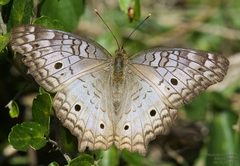
Distinguished from the banded peacock (Anartia fatima) by its white rather than orange-brown base wing color and less contrasting wing bars. The white peacock has more numerous and smaller eyespots compared to some related . In the United States, it is the only Anartia species regularly found in Florida and Texas; A. fatima is a rare stray to Texas and Kansas. The combination of white wings with dark marginal bands and orange-ringed eyespots is distinctive among North American nymphalids.
Images
Appearance
have white wings with dark brown to blackish marginal bands and two to four eyespots on each forewing and hindwing. The eyespots are typically ringed with orange or yellow. The wing surface shows more prominent patterning than the surface, which is paler with reduced markings. The body is relatively robust for a nymphalid, with reduced forelegs characteristic of the brush-footed butterflies. Wingspan ranges from approximately 45-70 mm.
Habitat
Occurs in disturbed open meadows, swampy areas, and wetland edges where larval plants grow. In Florida, males defend territories in swampy areas containing water hyssop. Found in tropical and subtropical regions including rainforest edges, savannas, and anthropogenic such as roadsides and agricultural areas.
Distribution
Southeastern United States (Florida, Texas), Central America, and South America from Venezuela to northern Argentina. Seven recognized with distinct geographic ranges: A. j. jatrophae (South America, Venezuela to Argentina), A. j. luteipicta (Central America, Mexico to Colombia), A. j. guantanamo (Florida and Cuba), A. j. semifusca (Puerto Rico), A. j. saturata (Brazil), A. j. jamaicensis (Jamaica), and A. j. intermedia (Saint Croix).
Seasonality
Active year-round in tropical portions of its range. In temperate areas of the United States, are most commonly observed from spring through fall. Peak abundance in Florida study sites occurred during morning hours (0900-1159).
Diet
feed on nectar from tropical flowers including . Larvae are herbivores on plants in the Plantaginaceae and Acanthaceae .
Host Associations
- Bacopa monnieri - larval plantwater hyssop; primary in Florida territories
- Bacopa caroliniensis - larval plantlemon bacopa
- Bacopa innominata - larval planttropical waterhyssop
- Phyla nodiflora - larval plantfrogfruit
- Phyla lanceolata - larval plantlanceleaf frogfruit
- Ruellia caroliniana - larval plantCarolina wild petunia
Life Cycle
Complete with , larva, pupa, and stages. Larvae feed on plants before pupating. Adults emerge and may live for several weeks under favorable conditions. Multiple per year in tropical .
Behavior
Males establish and defend roughly circular territories approximately 15 meters in diameter that contain larval plants. They perch within these territories and aggressively chase males and other flying insects that enter the area. Encounters with rival males last approximately 38 seconds on average, three times longer than encounters with non-conspecific insects. When male exceeds , site fidelity decreases and previously undefended areas become occupied. exhibit thermoregulatory including basking, fanning, and roosting that correlate with ambient temperature and time of day.
Ecological Role
serve as of tropical flowers. Larvae are herbivores that transfer energy from wetland plants to higher . The has been observed as prey for spiders and other .
Human Relevance
Occasionally kept in houses and exhibits. Not considered a pest . Subject of scientific research on territoriality and mating systems. Attracted to garden flowers in its native range.
Similar Taxa
- Anartia fatimaBanded peacock has orange-brown rather than white base wing color with more contrasting dark wing bars; occurs sympatrically in Central America and is a rare stray to southern Texas
- Junonia coeniaCommon buckeye shares eyespot patterning but has more prominent eyespots with blue centers and brown rather than white ground color; lacks the clean white wings with dark marginal bands of A. jatrophae
More Details
Subspecies Controversy
The validity of designations in A. jatrophae has been debated for decades. Molecular studies using mitochondrial barcodes support recognition of at least four distinct genetic lineages corresponding to A. j. jatrophae, A. j. luteipicta, A. j. saturata, and A. j. semifusca. Some earlier authorities considered the due to seasonal variation in within .
Territoriality Research
Robert Lederhouse and colleagues conducted landmark studies on male territorial in Florida Everglades , demonstrating that territory quality (presence of larval plants) directly influences mating success. This system has been cited as an example of resource-defense in insects.
Sources and further reading
- BugGuide
- Wikipedia
- GBIF taxonomy match
- iNaturalist taxon
- NCBI Taxonomy
- Catalogue of Life
- Destination Toucan Ridge, Belize to visit beautiful peacock butterflies: White peacock butterfly, Anartia jatrophae, and banded peacock butterfly, Anartia fatima and learn their dating games — Bug of the Week
- Dating games of peacock butterflies: White peacock butterfly, Anartia jatrophae, and banded peacock butterfly, Anartia fatima — Bug of the Week
- Archive — Bug of the Week
- Bug of the Week Academy Awards 2016 — Bug of the Week
- Thermoregulatory Behaviours of Anartia jatrophae (Insecta: Lepidoptera: Nymphalidae): A Baseline study
- Host plant-based territoriality in the white peacock butterfly,Anartia jatrophae (Lepidoptera: Nymphalidae)
- Mitochondrial DNA barcodes provide insight into the phylogeography and subspecies controversy in the widespread Neotropical white peacock butterfly,Anartia jatrophae(Nymphalidae: Nymphalinae)