
Phyciodes graphica
Felder, 1869
Vesta Crescent
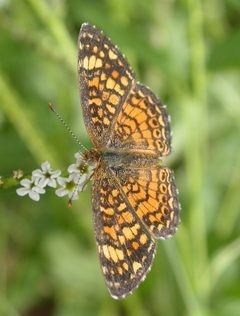
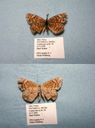
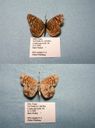
Phyciodes graphica, commonly known as the vesta crescent, is a in the Nymphalidae. It is currently recognized as a of Phyciodes vesta (P. vesta graphica) in some taxonomic treatments, though it has historically been treated as a distinct species. The vesta crescent belongs to a group of small to medium-sized butterflies known as crescents and checkerspots, characterized by their orange and black patterned wings.
Pronunciation
How to pronounce Phyciodes graphica: /ˌfaɪsiˈoʊdiːz ˈɡræfɪkə/
These audio files are automatically generated. While they are not always 100% accurate, they are a good starting point.
Identification
The vesta crescent can be distinguished from the closely related pearl crescent (Phyciodes tharos) by its more linear, finer black markings on the forewings and generally paler orange coloration. The pearl crescent tends to have bolder, more irregular black patches. The vesta crescent also shows reduced dark markings on the underside of the hindwings compared to some . Accurate identification often requires examination of wing pattern details and geographic location, as several Phyciodes overlap in range and are visually similar.
Images
Appearance
As a member of the Phyciodes, the vesta crescent exhibits the typical crescent : small to medium size with rounded wings. The upper wing surfaces display orange and black checkered or banded patterns, with distinctive crescent-shaped markings on the hindwing margins that give the group its . Wing patterns are generally more subdued compared to some related , with finer black markings on an orange background.
Habitat
Open sunny areas including fields, pastures, meadows, and roadsides. Associated with areas supporting larval plants in the aster (Asteraceae).
Distribution
North America. The exact range is imperfectly documented due to historical taxonomic confusion with related , particularly Phyciodes tharos. Records suggest occurrence across much of the United States, though precise boundaries require verification.
Seasonality
are active during the warmer months. Multiple occur annually in southern portions of the range; fewer generations in northern areas. Exact varies by region and requires local verification.
Diet
feed on nectar from a variety of flowering plants. Larvae feed on plants in the aster (Asteraceae), though specific host plant records for P. graphica require confirmation due to taxonomic confusion with related .
Host Associations
- Asteraceae - larval plantsSpecific require verification; likely includes asters (Symphyotrichum) and related genera based on genus-level patterns
Life Cycle
Complete with , larva, pupa, and stages. Larvae overwinter in in temperate regions, completing development in spring. Multiple per year in favorable climates.
Behavior
are active fliers in open sunny . Males may establish territories and patrol for females. Both sexes visit flowers for nectar.
Ecological Role
serve as of flowering plants. Larvae function as herbivores on their plants. Both life stages provide food for various and .
Human Relevance
Occasional subject of watching and photography. No significant economic or agricultural impact documented. Taxonomic status has been subject to revision, affecting identification guides and range maps.
Similar Taxa
- Phyciodes tharos (Pearl Crescent)Extremely similar wing patterns; distinguished by bolder, more irregular black forewing markings and generally darker orange coloration. Geographic overlap and hybridization potential complicate field identification.
- Phyciodes phaon (Phaon Crescent)Overlaps in range; typically distinguished by more extensive dark markings on hindwing underside and different season in some regions.
- Phyciodes cocyta (Northern Crescent)Northern distribution overlap; generally darker with more extensive black markings, though variable and sometimes indistinguishable without detailed examination.
More Details
Taxonomic Note
Phyciodes graphica has undergone repeated taxonomic revision. It was originally described as a full (Eresia graphica Felder, 1869), later treated as a of Phyciodes vesta (P. vesta graphica), and has sometimes been synonymized with Phyciodes tharos. Current treatments vary by source: Catalogue of Life and GBIF list it as a synonym of Phyciodes vesta, while other sources maintain species status. This taxonomic instability affects range maps, plant records, and identification keys.
Identification Caution
Field identification of Phyciodes is notoriously difficult due to phenotypic plasticity, hybridization, and overlapping character ranges. Definitive identification often requires examination of genitalia or molecular analysis, particularly in areas of sympatry.
Sources and further reading
- BugGuide
- Wikipedia
- GBIF taxonomy match
- iNaturalist taxon
- NCBI Taxonomy
- Catalogue of Life
- Virtual Reality Bugs: An Incredible Experience | Bug Squad
- Bug Spotlight | Entomology Research Museum
- Designing, Producing, and Communicating Effective Scientific Graphical Abstracts
- Graphical Abstracts: Where to Find Illustration and Design Help for Your Next Paper
- Stylish Lepidoptera: Ermine Moth, Atteva aurea; Yellow-Collared Scape Moth, Cisseps fulvicollis; Pearl Crescent, Phyciodes tharos; Variegated Fritillary, Euptoieta claudia — Bug of the Week
- Bug Eric: City Nature Challenge 2023 Recap