
Phyciodes phaon
(Edwards, 1864)
Phaon crescent, mat plant crescent, crescent spot
Phyciodes phaon is a small of the southeastern United States, the Caribbean, and extending west to New Mexico. are active from early spring through late fall in northern portions of the range, with nearly year-round activity in peninsular Florida. The is closely associated with fogfruit plants ( nodiflora), on which females lay in clusters on leaf undersides. Males patrol open areas near host plants to locate females, with mating concentrated at mid-day.
Pronunciation
How to pronounce Phyciodes phaon: //faɪˈsaɪ.əˌdiːz ˈfeɪ.ɒn//
These audio files are automatically generated. While they are not always 100% accurate, they are a good starting point.
Identification
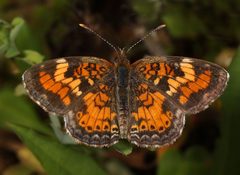
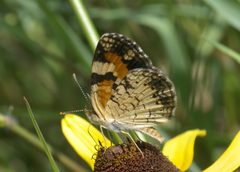
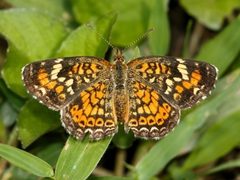
Medium-sized crescent with orange and black patterned wings. Distinguished from similar Phyciodes by geographic range and plant association; occurs in Florida and southeastern states where other crescents may be sympatric. The "phaon" refers to the specific epithet rather than a descriptive trait.
Images
Habitat
Open areas near plants, including disturbed , roadsides, and wet areas where fogfruit grows. Associated with low-growing vegetation in sunny to partially shaded locations.
Distribution
Southeastern United States from Florida north to neighboring states, west to New Mexico; Caribbean including Cuba (established since 1930s) and Cayman Islands.
Seasonality
Multiple periods from early spring to late fall in northern range; nearly continuous breeding year-round in peninsular Florida.
Diet
feed on nectar; larvae feed on leaves of fogfruit plants, particularly nodiflora (turkey tangle fogfruit) throughout much of Florida.
Host Associations
- Phyla nodiflora - primary larval turkey tangle fogfruit; common throughout much of Florida
- Phyla - larval fogfruit
Life Cycle
laid in clusters on undersides of plant leaves. Larvae develop on host foliage. and follow; multiple per year in warm climates, with continuous breeding possible in Florida. Part-grown larvae may overwinter in colder portions of range.
Behavior
Males patrol open areas near plants to locate females. Mating occurs primarily during mid-day. are active fliers and visit flowers for nectar.
Ecological Role
Herbivore as larva; as . Serves as prey for various . Specialized relationship with fogfruit plants may influence local plant .
Similar Taxa
- Phyciodes tharosPearl crescent; overlaps in eastern range but primarily uses asters as larval rather than fogfruit
- Phyciodes mylittaMylitta crescent; western breeding on thistles, not fogfruit
- Phyciodes campestrisField crescent; western , regionally extinct from some low-elevation California sites due to climate-related factors
Sources and further reading
- BugGuide
- Wikipedia
- GBIF taxonomy match
- iNaturalist taxon
- NCBI Taxonomy
- Catalogue of Life
- Art Shapiro: 'Using Butterflies to Understand Biotic Responses to Climate Change' | Bug Squad
- Where Are All the Butterflies? | Bug Squad
- Mylitta Crescent: Thistle Lover | Bug Squad
- Bug Squad
- Stylish Lepidoptera: Ermine Moth, Atteva aurea; Yellow-Collared Scape Moth, Cisseps fulvicollis; Pearl Crescent, Phyciodes tharos; Variegated Fritillary, Euptoieta claudia — Bug of the Week
- Bug Eric: City Nature Challenge 2023 Recap
- LIFE HISTORY AND BIOLOGY OF PHYCIODES PHAON (LEPIDOPTERA: NYMPHALIDAE)
- Influence of Dietary Lipids on Survival of Phyciodes phaon Butterflies (Lepidoptera: Nymphalidae)