
Chlosyne leanira
(C. Felder & R. Felder, 1860)
Leanira Checkerspot
Chlosyne leanira, commonly known as the Leanira Checkerspot, is a in the Nymphalidae, tribe Melitaeini. It occurs in western North America from Oregon through California, Nevada, Utah, western Colorado, and south to Baja California. The exhibits in size and coloration, with females larger but males displaying more prominent red wing markings. Larvae are specialized feeders on Castilleja species (Orobanchaceae) and overwinter in the third instar.
Pronunciation
How to pronounce Chlosyne leanira: /ˈkloʊsaɪni liˈænɪrə/
These audio files are automatically generated. While they are not always 100% accurate, they are a good starting point.
Identification
Distinguished from similar checkerspot butterflies by combination of: dark brown ground color with red (not orange) marginal lunules on forewings; more prominent red coloration in males; specific wing pattern of macules rather than bands. identification requires examination of precise distribution and subtle wing pattern differences. Differs from Chlosyne lacinia (Bordered Patch) in having red rather than orange markings and more restricted western distribution.
Images
Appearance
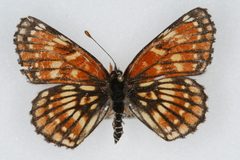
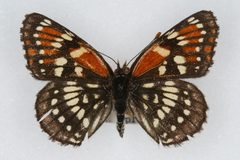
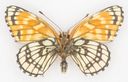
Wingspan 33–40 mm, with females (36–40 mm) larger than males (33–35 mm). Upper wing surface dark brown with small macules; forewings have red at base and apex, with red marginal lunules more conspicuous in males. Undersurface of forewings orange-red with pale and dark markings; hindwing undersurface with sub-basal fascia extending across , , and inner margin.
Habitat
Occupies diverse including grasslands, chaparral, oak woodland, and forested areas with Castilleja plants. Documented in areas with prescribed fire history, unburned forest, and fuel break areas. Associated with habitats receiving approximately 51 cm precipitation, characterized by warm dry summers and cool moist winters.
Distribution
Western North America: western Oregon, California, Nevada, Utah, western Colorado, and Baja California. Multiple with restricted ranges: C. l. oregonensis (Oregon), C. l. leanira and C. l. obsoleta (California), C. l. alma (Arizona, Utah), C. l. basinensis (Nevada), C. l. austrima (Baja California), and others.
Seasonality
active during warmer months; single observed at Gates Canyon, California between 1976–2002. Third-instar larvae hibernate and overwinter.
Diet
Larvae feed on Castilleja (Orobanchaceae), consuming leaves and flowers. Specific records include Castilleja integra for C. l. fulvia. feed on flower nectar; subspecies show preferences for particular flower colors and species, including white Achillea millefolium lanulosa, yellow Asteraceae, white Allium textile, and others.
Host Associations
- Castilleja integra - larval plant C. l. fulvia
- Castilleja - larval plant-level for
- Achillea millefolium lanulosa - nectar source C. l. leanira
- Allium textile - nectar source C. l. fulvia
- Heterotheca villosa - nectar source C. l. fulvia
- Ceanothus fendleri - nectar source C. l. fulvia
- Leucelene ericoides - nectar source C. l. alma
Life Cycle
laid on plants. Young larvae live together in loose web. Third-instar larvae enter hibernation and overwinter. Examination of specimens in Gates Canyon, California confirmed occurs in larval stage. and follow in subsequent season.
Behavior
Young larvae exhibit gregarious , living communally in loose silk webs. have been observed feeding at flowers with -specific preferences for flower color and .
Ecological Role
Larval herbivore on Castilleja ; . Member of Melitaeini tribe, which includes approximately 250 species in five generic groups. Phylogenetic analyses place Chlosyne group species as Nearctic in distribution.
Human Relevance
Subject of entomological study and observation. Multiple described based on geographic variation. Documented in long-term butterfly monitoring studies (e.g., Gates Canyon, California 1976–2002).
Similar Taxa
- Chlosyne laciniaSimilar checkerspot pattern but with orange (not red) wing markings and broader distribution including eastern North America
- Thessalia speciesPhylogenetically related; some formerly placed in Chlosyne. Chlosyne leanira was historically classified as Thessalia leanira; male genitalia distinguishes generic placement
More Details
Taxonomic History
has undergone taxonomic revision. Originally described as Melitaea leanira (1860), later transferred to Chlosyne. Phylogenetic analyses using mitochondrial have supported monophyly of Chlosyne group but suggested paraphyly of related . Some analyses suggest Chlosyne may be synonymous with Thessalia, though sufficient sequence divergence supports maintaining separate genera. Species has been variously classified under Chlosyne, Thessalia, and Melitaea in historical literature.
Subspecies Diversity
Eleven recognized, most with restricted geographic distributions in California. Subspecies include: oregonensis (Oregon), leanira, obsoleta, nebularum, elegans, wrightii, cerrita, flavodorsalis (California), alma (Arizona, Utah), basinensis (Nevada), and austrima (Baja California). Subspecies distinguished by minor wing pattern differences and geographic isolation.
Population Rarity
Some appear locally rare. Only six individuals of C. l. wrightii observed over 8-year period in Hall Canyon, Ventura County, California. Absent from Sutter Buttes, California despite apparently suitable , suggesting additional factors influence distribution.