
Chlosyne harrisii
(Scudder, 1862)
Harris's checkerspot
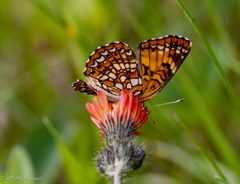
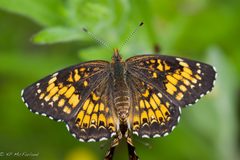
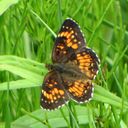
Chlosyne harrisii, or Harris's checkerspot, is a North American in the Nymphalidae. It is a Batesian mimic of the unpalatable Baltimore checkerspot (Euphydryas phaeton), sharing similar orange and black checkered wing patterns. The has a single period in early summer and is closely associated with wet meadow where its plant, flat-topped white aster (Aster umbellatus), grows. It is listed as a species of special concern and believed extirpated in Connecticut.
Pronunciation
How to pronounce Chlosyne harrisii: //kloʊˈsaɪni ˈhærɪsaɪ//
These audio files are automatically generated. While they are not always 100% accurate, they are a good starting point.
Identification
are often confused with the silvery checkerspot (Chlosyne nycteis). Distinguished from Euphydryas phaeton by close examination of wing pattern details, though the two are remarkably similar in appearance as part of their mimetic relationship. The single red-orange stripe on the underside of the hindwing is a key feature.
Images
Habitat
Bogs, meadows, and wet areas where the plant flat-topped white aster (Aster umbellatus) occurs. Elevation range 0–1,742 feet (0–531 m).
Distribution
North America: Canadian Atlantic provinces (excluding Newfoundland and Labrador) west to Manitoba and North Dakota, south to West Virginia and Ohio.
Seasonality
One period occurs between June and July. are active during this brief window in early summer.
Diet
feed on flower nectar. Larvae feed exclusively on flat-topped white aster (Aster umbellatus).
Host Associations
- Aster umbellatus - larval plantFlat-topped white aster; sole known plant for caterpillars
Life Cycle
Females lay in clusters under leaves of plants. Caterpillars feed on Aster umbellatus and overwinter during their third instar. occurs in spring, with emerging in June.
Behavior
participate in a complex with Euphydryas phaeton. Both are unpalatable to and share synchronized and overlapping periods in wet meadow . Blue jays and other visual predators have difficulty distinguishing between the two species.
Ecological Role
Member of a Müllerian mimicry ring with Euphydryas phaeton, contributing to avoidance through shared aposematic coloration. Larvae are specialized herbivores on Aster umbellatus.
Human Relevance
Subject of conservation concern; listed as a of special concern and believed extirpated in Connecticut. Used in scientific studies of mimicry and learning.
Similar Taxa
- Chlosyne nycteisSilvery checkerspot; frequently confused with C. harrisii due to similar size and checkered pattern
- Euphydryas phaetonBaltimore checkerspot; remarkably similar in appearance due to in mimicry complex, with virtually identical larvae and very similar wing undersurfaces
More Details
Conservation status
Listed as a of special concern and believed extirpated in the US state of Connecticut.
Mimicry research
Feeding experiments with blue jays demonstrated that C. harrisii is palatable but visually indistinguishable from E. phaeton, confirming its role as a Batesian mimic.
Sources and further reading
- BugGuide
- Wikipedia
- GBIF taxonomy match
- iNaturalist taxon
- NCBI Taxonomy
- Catalogue of Life
- Bug Eric: Bosque del Apache National Wildlife Refuge
- Bug Eric: January 2016
- 2018 Arizona Insect Collecting Trip “iReport” | Beetles In The Bush
- Mimicry in North American checkerspot butterflies: Euphydryas phaeton and Chlosyne harrisii (Nymphalidae)