
Chlosyne gorgone
(Hübner)
Gorgone Checkerspot
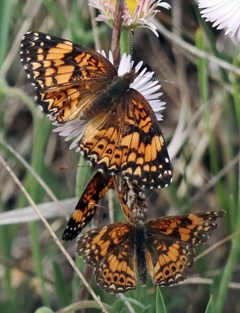
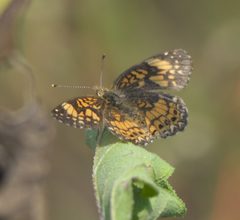
Chlosyne gorgone is a Nymphalinae occurring across central North America. have orange wings with black markings and a wingspan of 32–45 mm. Larvae feed on Asteraceae plants including Helianthus, Ambrosia, Iva, and Viguiera ; adults visit nectar sources, particularly yellow flowers. The species exhibits geographic variation in number, with one in the north and up to three in the south.

Pronunciation
How to pronounce Chlosyne gorgone: /kloʊˈsaɪni ˈɡɔrɡoʊn/
These audio files are automatically generated. While they are not always 100% accurate, they are a good starting point.
Identification
Distinguished from similar checkerspots by the submarginal row of solid black dots on the hindwing surface, combined with the zigzag brown-and-white banding pattern. The white chevron band on the ventral surface is particularly distinctive. Range and period help separate from other Chlosyne where sympatric.
Images
Habitat
Open areas including ridges, prairies, old fields, streamsides, and open hardwood forests. Occurs in both dry and mesic conditions within these open .
Distribution
North America from Alberta east to southern Ontario, south to central Texas, primarily between the Rocky Mountains and Appalachians. Present in Canadian provinces of Alberta, Saskatchewan, and Manitoba; widespread in the United States from the Great Plains to the Midwest and south-central regions.
Seasonality
period varies geographically: one July–August in northern range; two broods May–September in mid-range; three broods April–September in southern range.
Diet
Larvae feed on leaf tissue of Asteraceae : Helianthus (sunflowers), Ambrosia trifida (giant ragweed), Iva xanthifolia (marsh elder), and Viguiera multiflora. feed on nectar, with preference for yellow flowers.
Host Associations
- Helianthus species - larval food plant
- Ambrosia trifida - larval food plant
- Iva xanthifolia - larval food plant
- Viguiera multiflora - larval food plant
- Echinacea pallida - larval food plantDocumented in Wisconsin prairie; single observation of eight larvae feeding on upper leaf surface
Life Cycle
Females deposit in clusters on undersides of plant leaves. Early instar larvae feed gregariously; third-instar caterpillars enter hibernation. Complete number of varies with latitude (1–3 ).
Behavior
Larvae exhibit group feeding , particularly in early instars. Feeding damage on leaves is characteristic: larvae consume upper leaf surface tissue while leaving the translucent lower intact, creating elongated feeding areas along the leaf axis.
Similar Taxa
- Chlosyne laciniaSimilar orange-and-black checkerspot pattern, but distinguished by wing pattern details and typically more southern distribution
- Other Chlosyne speciesMultiple checkerspot overlap in range; precise wing pattern characters and geographic location required for identification
More Details
Larval feeding behavior
A 1994 observation in Wisconsin documented eight larvae feeding in on Echinacea pallida, consuming upper leaf tissue while leaving lower intact—creating distinctive translucent 'windows' on the leaf surface.
Brood variation
The demonstrates clinal variation in voltinism, with in the north transitioning to trivoltine populations in the south. This pattern reflects to growing season length across the range.
Sources and further reading
- BugGuide
- Wikipedia
- GBIF taxonomy match
- iNaturalist taxon
- NCBI Taxonomy
- Catalogue of Life
- Bug Eric: Bosque del Apache National Wildlife Refuge
- Bug Eric: January 2016
- 2018 Arizona Insect Collecting Trip “iReport” | Beetles In The Bush
- New Larval Host Plant and Behavior of <i>Chlosyne Gorgone</i> (Lepidoptera: Nymphalidae)