
Chlosyne acastus
(Edwards, 1874)
Sagebrush Checkerspot
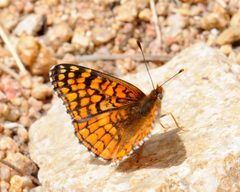
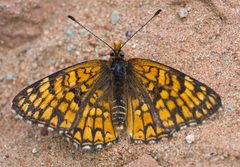
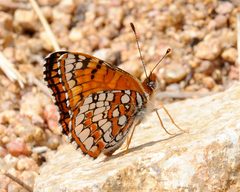
Chlosyne acastus, the sagebrush checkerspot, is a in the Nymphalidae native to western North America. have a wingspan of 33–44 mm and display the characteristic orange and black checkered pattern typical of the . The has one period annually, with adults active from May through early September. Larvae feed on specific Asteraceae plants, with documented utilization of rabbit-brush, desert-aster, woolly sunflower, arrowleaf balsamroot, and common sunflower.
Pronunciation
How to pronounce Chlosyne acastus: //kloʊˈsaɪni əˈkæstəs//
These audio files are automatically generated. While they are not always 100% accurate, they are a good starting point.
Identification
may be confused with the northern checkerspot (Chlosyne palla) and Hoffmann's checkerspot (Chlosyne hoffmanni). Accurate identification requires examination of wing pattern details and geographic location. The submarginal band pattern and forewing markings differ among these similar .
Images
Habitat
Sagebrush-dominated and associated open areas in western North America. Occurs in shrub-steppe, grassland, and open woodland environments where larval plants grow.
Distribution
Western United States east to Nebraska, north to southern Alberta and Saskatchewan in Canada. Present throughout the intermountain west and Great Basin regions.
Seasonality
One period annually. active from May through early September, with peak activity varying by latitude and elevation. In Canada, flight occurs between May and early September.
Diet
Larvae feed on Asteraceae plants including rabbit-brush (Chrysothamnus viscidiflorus), desert-aster (Machaeranthera ), woolly sunflower (Eriophyllum lanatum), arrowleaf balsamroot (Balsamorhiza sagittata), and common sunflower (Helianthus annuus). Larval survival and development rates vary significantly among host species, with Eriophyllum lanatum supporting highest survival. feeding habits not documented in available sources.
Host Associations
- Chrysothamnus viscidiflorus - larval Rabbit-brush
- Machaeranthera - larval Desert-aster
- Eriophyllum lanatum - larval Woolly sunflower; supports highest larval survival and fastest development
- Balsamorhiza sagittata - larval Arrowleaf balsamroot
- Helianthus annuus - larval Common sunflower; poor larval performance documented
Life Cycle
Complete with one annually. laid on plants. Larval development time and survival vary by host plant . occurs in late summer or fall, with emerging the following spring. stage not explicitly documented in available sources.
Ecological Role
Herbivore in larval stage; contributes to pollination as . Serves as prey for various . Specialized relationship with native Asteraceae plants may influence plant dynamics in sagebrush .
Human Relevance
Subject of ecological research on plant relationships and larval development. Not documented as an agricultural pest or significant of crop plants.
Similar Taxa
- Chlosyne pallaNorthern checkerspot; similar orange and black checkered wing pattern, overlapping range in western North America
- Chlosyne hoffmanniHoffmann's checkerspot; similar appearance and checkered pattern, requires careful examination for separation
More Details
Subspecies
Two recognized: C. a. neumoegeni (Skinner, 1895) and C. a. sabina (Wright, 1905). Subspecies C. a. sterope has been studied in south central Washington.
Conservation Status
Not assessed in major conservation frameworks; common throughout range with no documented declines.
Sources and further reading
- BugGuide
- Wikipedia
- GBIF taxonomy match
- iNaturalist taxon
- NCBI Taxonomy
- Catalogue of Life
- Bug Eric: Bosque del Apache National Wildlife Refuge
- Bug Eric: January 2016
- 2018 Arizona Insect Collecting Trip “iReport” | Beetles In The Bush
- Development and Survival ofChlosyne acastus sterope(Lepidoptera: Nymphalidae) Larvae on Three Host Plants in South Central Washington