
Chlosyne hoffmanni
(Behr, 1863)
Hoffmann's Checkerspot
Chlosyne hoffmanni, commonly known as Hoffmann's checkerspot, is a in the Nymphalidae to western North America. The inhabits mountainous regions from the Sierra Nevada and Cascade ranges to southern British Columbia. It is a species with active in early summer. The caterpillars feed on Aster species, while adults consume flower nectar.

Pronunciation
How to pronounce Chlosyne hoffmanni: /ˈkloʊsɪni ˈhɔːfmæni/
These audio files are automatically generated. While they are not always 100% accurate, they are a good starting point.
Identification
may be confused with Chlosyne palla (northern checkerspot) and Chlosyne acastus (sagebrush checkerspot). Distinguishing characteristics from these similar are not explicitly documented in available sources.
Images
Appearance
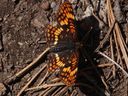
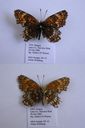
have a wingspan of 30–36 mm (1.2–1.4 in). Wing pattern consists of checkered orange and black markings typical of the .
Habitat
Mountainous regions including the Sierra Nevada and Cascade Mountains. Specific microhabitat preferences are not well documented.
Distribution
Western North America, ranging from the Sierra Nevada and Cascade Mountains in the United States northward to Manning Park in British Columbia, Canada.
Seasonality
One period occurs between June and early July in Canada. Timing in more southern portions of the range is not explicitly documented.
Diet
Caterpillars feed on Aster . feed on flower nectar.
Host Associations
- Aster - larval food plantcaterpillar
Life Cycle
with one per year. Complete with , larval, pupal, and stages. Detailed descriptions of stages are not available.
Ecological Role
may contribute to pollination through nectar feeding. Larvae function as herbivores on Aster .
Similar Taxa
- Chlosyne pallasimilar checkered orange and black wing pattern; frequently confused with C. hoffmanni
- Chlosyne acastussimilar checkered orange and black wing pattern; frequently confused with C. hoffmanni
More Details
Subspecies
Two are recognized: C. h. manchada Bauer, [1960] and C. h. segregata Barnes & McDunnough, 1918.
Nomenclature
Originally described as Melitaea hoffmanni by Behr in 1863; subsequently transferred to Chlosyne.