
Dryadula phaetusa
(Linnaeus, 1758)
Banded Orange Heliconian, Banded Orange, Orange Tiger
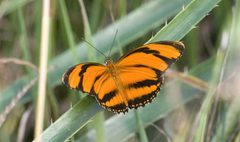
Dryadula phaetusa, the sole in its , is a Neotropical heliconiine recognizable by its bold orange and black banded wing pattern. It ranges from Brazil to central Mexico, with occasional summer vagrants reaching central Florida. The species exhibits in color intensity and participates in Müllerian mimicry complexes due to its unpalatability to birds.


Pronunciation
How to pronounce Dryadula phaetusa: /dɹaɪˈædʒʊlə fiˈtuːzə/
These audio files are automatically generated. While they are not always 100% accurate, they are a good starting point.
Identification
Distinguished from other orange heliconiines by its straight, evenly spaced black transverse bands across both forewings and hindwings, lacking the spotted or checkered patterns of related . in color intensity aids field identification: males are brighter with crisp stripes, females duller with blurred banding. Vagrant individuals in North America may be confused with monarchs or fritillaries but differ in banding pattern and style.
Images
Habitat
Lowland tropical fields and valleys; open disturbed including forest edges, agricultural clearings, and riverine corridors. Requires presence of larval plants (Passiflora ) and nectar sources.
Distribution
Native range extends from Brazil through Central America to central Mexico. Seasonal vagrancy documented as far north as central Florida, United States. Records from Colombia, Ecuador, and various Central American localities.
Seasonality
Active year-round in tropical portions of range. Summer vagrancy to subtropical North America (central Florida) during warmer months. Mud-puddling of males occur prior to mating season.
Diet
feed on floral nectar and bird droppings. Larvae feed on passion vines, specifically Passiflora tetrastylis and likely other Passiflora .
Host Associations
- Passiflora tetrastylis - larval plantprimary documented ; other Passiflora likely used
Life Cycle
Complete with , larval, pupal, and stages. Larvae feed on Passiflora foliage; adults emerge with bright warning coloration. Specific undocumented but likely continuous breeding in tropical .
Behavior
engage in mud-puddling: males aggregate by the hundreds on moist soil containing mineral salts prior to mating season. When mineral deposits unavailable, males have been observed drinking salty secretions from animal skin and nostrils. is slow and deliberate, typical of unpalatable heliconiine butterflies.
Ecological Role
pollination of nectar plants. Larval herbivory on Passiflora. Member of Müllerian mimicry complex: unpalatable to birds, shares orange warning coloration with other unpalatable , reinforcing avoidance learning.
Human Relevance
Minor significance as occasional vagrant to southern United States, of interest to watchers. No known agricultural or economic impact. Studied as example of Müllerian mimicry and mud-puddling .
Similar Taxa
- Dryas iulia (Julia Heliconian)Similar orange coloration but has elongated forewings and spotted rather than banded pattern; lacks crisp transverse stripes
- Agraulis vanillae (Gulf Fritillary)Smaller with silvery spots and more checkered pattern; not banded
- Euptoieta hegesia (Mexican Fritillary)Checkered orange and black pattern with distinct markings; banding less regular
- Danaus plexippus (Monarch)Vagrant overlap in Florida; monarch has veined rather than banded pattern, different wing shape, and faster
More Details
Müllerian Mimicry
This belongs to the 'orange' Müllerian mimicry complex, where multiple unpalatable species converge on similar warning coloration to reduce pressure through shared education.