
Dryas iulia
(Fabricius, 1775)
Julia butterfly, Julia heliconian, flame, flambeau
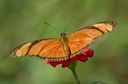
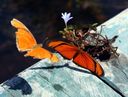
Dryas iulia is the sole in its , a native from Brazil to southern Texas and Florida, with occasional summer records as far north as eastern Nebraska. It exhibits bright orange wings with black markings, with males displaying more vivid coloration than females. The species is unpalatable to birds due to cyanogenic glycosides sequestered from its Passiflora plants, placing it within the "orange" Müllerian mimicry complex. are fast fliers and active throughout the day.
Pronunciation
How to pronounce Dryas iulia: //ˈdraɪəs ˈjuːliə//
These audio files are automatically generated. While they are not always 100% accurate, they are a good starting point.
Identification
are distinguished by elongated orange wings with black markings concentrated near the wing tips; males exhibit brighter orange coloration compared to the duller orange of females. Wingspan ranges from 82 to 92 mm. Larvae display pink, gray, and black coloration with maroon and cream patches, covered in long, branched black spines, with a cream-colored inverted Y-shaped mark on the . Pupae are grayish-white and resemble dead leaves. Over 15 have been described, with variation in black wing markings.
Images
Habitat
Inhabits tropical and subtropical forests, favoring open, sunny breaks including clearings, paths, and forest margins. Also occurs in human-modified open areas such as gardens, cattle grazing lands, and forest clearings.
Distribution
Native from Brazil through Central America to southern Texas and Florida; widespread throughout Caribbean islands with in Cuba, Dominica, Bahamas, and Puerto Rico. Summer vagrant records extend as far north as eastern Nebraska. Introduced and established wild in Thailand and Malaysia.
Seasonality
occur year-round in southern Florida and southern Texas, with peak activity during fall. Northward to Nebraska occurs during summer months.
Diet
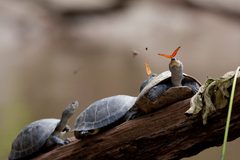
feed on nectar from flowers including , Eupatorium, Scandix pecten-veneris, and shepherd's-needle. Males engage in mud-puddling to obtain dissolved minerals for production. Adults have been observed drinking tears from caiman and turtle , and eye secretions from sleeping birds, obtained by irritating the eye surface. Larvae feed almost exclusively on Passiflora leaves, showing strong preference for P. misera based on nitrogen content, with documented consumption of P. pohlii, P. suberosa, and rejection of P. edulis.
Life Cycle
Holometabolous development with five larval instars. are light yellow when laid, darkening to orange or brown before hatching; approximately 1.2 mm height by 1.0 mm diameter with 20 vertical and 13 horizontal ridges. Larvae feed on plant leaves, resting on remaining leaf portions for protection. occurs after the fifth instar; lifespan is less than one month. Mating can occur within two weeks of ; females can mate up to four times in their lifetime, which is unusual for Heliconius butterflies.
Behavior
Fast, agile typically in the middle story of forest . roost close to the ground at night, either solitarily or in small groups. Complex courtship involves three sequential phases (aerial, air-ground, ground) with female-controlled copulation acceptance. Successful males exhibit more stereotyped behavioral sequences with fewer transitions. Males actively search for mates throughout adult life. Mud-puddling occurs in , with males crowding at damp ground sites. Larvae may exhibit adaptive behaviors to avoid .
Ecological Role
Herbivore in the Heliconiini-Passiflora coevolutionary system. Unpalatable to due to sequestered cyanogenic glycosides, contributing to Müllerian mimicry with other orange Heliconian . Larval feeding on Passiflora influences plant defensive trait evolution including tough leaves, -mimicry structures, and decoy leaf production.
Human Relevance
Popular in houses due to long lifespan and activity. Caterpillars can cause skin rash in humans upon contact, likely from defensive secretions at spine tips. Introduced in Southeast Asia have become established and are considered non-eradicable; these feed on Passiflora .
Similar Taxa
- Agraulis vanillaeGulf fritillary overlaps in range and shares orange coloration with black markings; however, D. iulia has more elongated wings and distinct wing shape, and the two have been documented in competitive interactions where D. i. moderata may fight with gulf fritillaries in overlapping breeding areas.
- Heliconius speciesMultiple Heliconius share the orange Müllerian mimicry complex; D. iulia is distinguished by being the sole member of Dryas with unique wing venation and pattern arrangement, and by larval plant associations.
Sources and further reading
- BugGuide
- Wikipedia
- GBIF taxonomy match
- iNaturalist taxon
- NCBI Taxonomy
- Catalogue of Life
- Bohart Bugs Beckon at Vacaville Museum's Exhibit | Bug Squad
- Scientific Annals of the Danube Delta Institute | Blog
- New Pensoft journals | Blog
- Pensoft Editorial Team | Blog - Part 13
- Pensoft Editorial Team | Blog - Part 10
- Dryas iulia (Lepidoptera, Nymphalidae) larval preference and performance on four sympatric Passiflora hosts
- Analysis of the mating behavior and some possible causes of male copulatory success in Dryas iulia alcionea (Lepidoptera, Nymphalidae, Heliconiinae)
- Do caterpillars ofDryas iulia alcionea(Lepidoptera, Nymphalidae) show evidence of adaptive behaviour to avoid predation by ants?