
Speyeria mormonia
(Boisduval, 1869)
Mormon fritillary
Species Guides
8- Speyeria mormonia artonis
- Speyeria mormonia bischoffii
- Speyeria mormonia erinna(Mormon Fritillary)
- Speyeria mormonia eurynome
- Speyeria mormonia luski
- Speyeria mormonia mormonia(Mormon Fritillary)
- Speyeria mormonia opis(Mormon Fritillary)
- Speyeria mormonia washingtonia(Washington's Fritillary)
Speyeria mormonia, commonly known as the Mormon fritillary, is a small montane distributed across western North America from the Yukon to California and Nevada. The exhibits extreme protandry, with males emerging at least two weeks before females, leading to skewed sex ratios toward males. It occupies diverse including rocky mountainsides, meadows, grasslands, and forest clearings, with typically occurring in small, semi-isolated patches. Multiple have been described, reflecting the species' broad geographic range and high genetic variability.
Pronunciation
How to pronounce Speyeria mormonia: //spaɪˈɛriə mɔrˈmoʊniə//
These audio files are automatically generated. While they are not always 100% accurate, they are a good starting point.
Identification
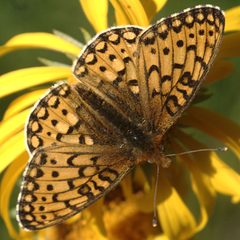
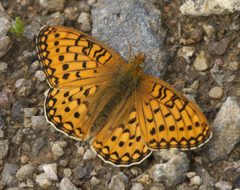
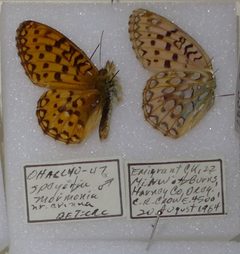
Smaller than other fritillaries in the Speyeria, with female wingspan 25–27 mm and males 23–26 mm (based on Colorado measurements). Upper wings are orange with small black patches; hindwing has a greenish tinge with light silver streaks that vary between (reflective quality in some, chalk white in others).
Images
Habitat
Occupies diverse montane including rocky mountainsides, saturated meadows, open grasslands, and clearings within pine forests. occur at higher elevations in both Canada and the United States. Populations tend to be distributed in small, semi-isolated patches; between sub-sites varies by population or .
Distribution
Western North America, from the Yukon through British Columbia and Alberta in Canada, south through the Rocky Mountains to California and Nevada in the United States. Present in Alberta, Manitoba, and Saskatchewan (Canada).
Seasonality
with one period from mid-July through early September. Males emerge and peak 2–3 weeks before females; both sexes conclude flight period simultaneously in late August to early September. Flight period duration correlates with weather patterns, with reduced rainfall associated with shorter flight periods.
Diet
Larvae feed on multiple of Viola (violets), including Viola dunce, V. canadensis, V. glabella, V. nephrophylla, V. orbiculata, and V. renifolia; no evidence for plant species preference. feed on nectar from Compositae plants and at mud puddles; adult females are more dependent on adult feeding for reproductive success than males.
Host Associations
- Viola dunce - larval plant
- Viola canadensis - larval plant
- Viola glabella - larval plant
- Viola nephrophylla - larval plant
- Viola orbiculata - larval plant
- Viola renifolia - larval plant
Life Cycle
are oviposited near plants in leaf debris, rarely on the plants themselves. Larvae are tan with black stripes; early instars through winter, resuming feeding as late instars on violet host plants. occurs with females pupating later than males, presumably to accumulate additional larval-derived nutrients for . lifespan ranges from 10–40 days based on four-year observation of a Colorado .
Behavior
Males actively search for mates by flying low over , while females are sedentary and often found on nectar plants. Males engage in mud puddling more frequently than females, sourcing sodium that is transferred to females during mating. Older females with low lifetime mating counts also puddle, presumably to replenish depleted sodium stores. Under resource stress, females reabsorb unlaid to reallocate nutrients from to survival, reducing . consists of short bursts; wild females estimated to fly 10–24 minutes per day.
Ecological Role
Larval herbivore on Viola ; of Compositae and other flowering plants.
Similar Taxa
- Speyeria cybeleSimilar orange and black wing pattern, but S. cybele is larger (wingspan 2.25–4 inches vs. 23–27 mm in S. mormonia) and has more prominent silvery spots on hindwing; S. cybele lacks the extreme protandry and small size characteristic of S. mormonia.
- Speyeria atlantisOverlapping geographic range and similar use; distinguished by larger size and different wing pattern details. S. atlantis was used in visual navigation studies demonstrating habitat detection primarily through vision, suggesting similar perceptual .
Sources and further reading
- BugGuide
- Wikipedia
- GBIF taxonomy match
- Catalogue of Life
- UC Davis Seminar: 'Insect Conservation in an Uncertain Future' | Bug Squad
- Bohart Museum Butterfly Donor Chuck Hageman Leaves a Lasting Legacy | Bug Squad
- Two other orange and black butterflies: Variegated fritillary, Euptoieta claudia, and great spangled fritillary, Speyeria cybele — Bug of the Week
- Speyeria atlantis Archives - Entomology Today
- The Eyes Have It: How Butterflies Navigate to Suitable Habitat
- USPS Issues Butterfly Postage Stamp
- Within population variation in the demography of Speyeria mormonia (Lepidoptera: Nymphalidae)
- The Effect of Adult Food Limitation on Life History Traits in Speyeria Mormonia (Lepidoptera: Nymphalidae)
- Effects of Increased Flight on the Energetics and Life History of the Butterfly Speyeria mormonia