
Speyeria mormonia erinna
(Edwards, 1882)
Mormon Fritillary
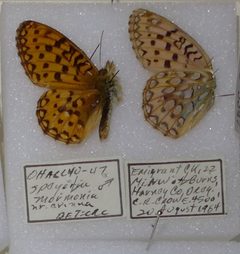
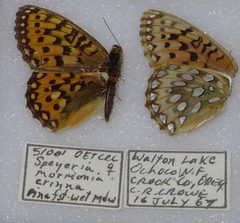
Speyeria mormonia erinna is a of the Mormon fritillary , a member of the brush-footed Nymphalidae. Like other Speyeria , it is closely associated with violet plants for larval development. Research on congeneric species has demonstrated that this group relies primarily on visual cues for navigation to suitable patches. The subspecies is distributed across prairie and montane regions of western Canada.
Pronunciation
How to pronounce Speyeria mormonia erinna: /ˈspaɪəriə mɔrˈmoʊniə ɛˈrɪnə/
These audio files are automatically generated. While they are not always 100% accurate, they are a good starting point.
Identification
Distinguished from other Speyeria mormonia by geographic range and subtle wing pattern variations. Females are typically darker than males, a pattern consistent across the . The undersides of wings display silvery spots characteristic of the group. Accurate identification to subspecies level requires examination of genitalia or geographic provenance.
Images
Habitat
Prairie and montane meadow in western Canada. Associated with open, sunny areas where violet plants occur.
Distribution
Recorded from Alberta, Saskatchewan, and Manitoba, Canada. Part of the broader North American range of Speyeria mormonia.
Diet
Larvae feed on violet (Violaceae). nectar at a variety of flowering plants.
Host Associations
- Viola - larval food plant laid on or near violet clumps; larvae feed on leaves after
Life Cycle
Females deposit on or near violet plants in late summer. First-instar larvae hatch and immediately enter , among leaf litter. Development resumes in spring with feeding on fresh violet foliage, followed by and in early summer. Males typically emerge before females.
Behavior
Strong, fast fliers. are active in open and demonstrate visual-based navigation to locate suitable habitat patches, as evidenced by experimental studies on congeneric .
Ecological Role
of meadow wildflowers. Larval herbivore on violets.
Similar Taxa
- Speyeria cybeleOverlaps in range and general appearance; distinguished by larger size, more extensive silvery spotting on wing undersides, and different geographic distribution
- Speyeria atlantisSimilar orange and black coloration; separated by wing pattern details and preferences, with S. atlantis typically occupying more northern and montane areas
More Details
Visual navigation research
Studies on Speyeria cybele and S. atlantis have established that fritillary butterflies rely primarily on visual perception rather than olfaction or wind cues for detecting and navigating to suitable patches. Flash-induced blindness experiments demonstrated near-total failure of habitat location, indicating vision is the sensory modality for this in the .
Conservation context
Like other Speyeria , S. mormonia erinna depends on intact prairie and meadow with abundant violet plants. Habitat fragmentation poses a significant threat to persistence due to the visual navigation limitations documented in congeneric species—butterflies released 60 meters from target habitat showed only 50% success in locating suitable patches.
Sources and further reading
- BugGuide
- GBIF taxonomy match
- Catalogue of Life
- UC Davis Seminar: 'Insect Conservation in an Uncertain Future' | Bug Squad
- Bohart Museum Butterfly Donor Chuck Hageman Leaves a Lasting Legacy | Bug Squad
- Two other orange and black butterflies: Variegated fritillary, Euptoieta claudia, and great spangled fritillary, Speyeria cybele — Bug of the Week
- Speyeria atlantis Archives - Entomology Today
- The Eyes Have It: How Butterflies Navigate to Suitable Habitat
- USPS Issues Butterfly Postage Stamp