
Boloria alberta
(W.H. Edwards, 1890)
Alberta fritillary
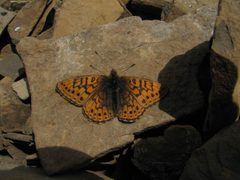
Boloria alberta is a small alpine fritillary to the North American Rocky Mountains. fly from July to early August in high-elevation . The exhibits in coloration, with males appearing dull orange and females pale orange to gray-brown. Larvae are specialized feeders on mountain avens (Dryas octopetala).
Pronunciation
How to pronounce Boloria alberta: //bəˈlɔː.ri.ə ælˈbɜr.tə//
These audio files are automatically generated. While they are not always 100% accurate, they are a good starting point.
Identification
Distinguished from sympatric fritillaries by blurred, indistinct wing markings and small size. Male dull orange coloration differs from brighter orange of related . Female gray-brown tones may cause confusion with worn individuals of other species; association (alpine ridges, tundra) provides additional context. Reduced pattern clarity contrasts with sharply marked Boloria species at lower elevations.
Images
Habitat
Alpine ridges, tundra, and windswept scree slopes above treeline. Occupies rocky, exposed terrain with sparse vegetation in high-elevation mountain systems.
Distribution
to North American Rocky Mountains: British Columbia, Alberta (Canada), and northern Montana (USA). Disjunct in Chukotka, Russia ( B. a. kurentzovi).
Seasonality
active July to early August. Single period annually; .
Diet
Larvae feed exclusively on mountain avens (Dryas octopetala, Rosaceae). nectar sources not documented in available sources.
Host Associations
- Dryas octopetala - larval plantMountain avens; required for larval development
Life Cycle
Complete (holometabolous). with single . stage not explicitly documented; inferred to be larval or pupal based on alpine Boloria patterns. emerge mid-summer for mating and oviposition.
Ecological Role
in alpine ; larval herbivore on Dryas octopetala. Member of high-elevation with limited capacity due to fragmentation.
Human Relevance
Subject of alpine conservation interest due to restricted range and specificity. Not known to be of economic importance.
Similar Taxa
- Boloria improbaOverlaps in alpine Rocky Mountain ; B. alberta distinguished by blurred markings and smaller size
- Boloria seleneSilver-bordered fritillary occurs in overlapping range but at lower elevations with sharper wing pattern definition
- Boloria titaniaMore widely distributed with clearer markings; not restricted to highest alpine zones
More Details
Subspecies
Two recognized : nominate B. a. alberta (North America) and B. a. kurentzovi (Chukotka, Russia), the latter described by Wyatt in 1961. Russian represents significant disjunction from core Rocky Mountain range.
Conservation status
Not formally assessed by IUCN; restricted range and alpine specificity suggest vulnerability to climate change and habitat alteration. Dependence on single larval plant increases sensitivity.
Sources and further reading
- BugGuide
- Wikipedia
- GBIF taxonomy match
- iNaturalist taxon
- NCBI Taxonomy
- “Cicindelophilically” | Beetles In The Bush
- Funding from ScottishPower Foundation helps to restore vital habitat to encourage thriving natural ecosystem - Buglife Blog - Buglife
- Do Managed Burns in Grasslands Benefit Butterflies?
- These are a few of my favorite trees | Beetles In The Bush
- Monroe Canyon epilogue – Audubon’s tiger beetle | Beetles In The Bush
- Guest Blogger: Dogbane for Dinner | Beetles In The Bush
- Genetic divergence and the Pleistocene history of the alpine butterflies Boloria improba (Nymphalidae) and the endangered Boloria acrocnema (Nymphalidae) in western North America