
Boloria improba
(Butler, 1877)
dingy fritillary
Boloria improba is a Holarctic alpine in the Nymphalidae, known as the dingy fritillary. The has a fragmented distribution spanning northern Scandinavia, northeastern Alaska, isolated Rocky Mountain in Wyoming and Colorado, and the Chukotka region of Russia. It inhabits alpine and tundra , typically associated with willow patches. The B. i. acrocnema (Uncompahgre fritillary) is federally endangered in the United States, listed in 1991, and serves as a habitat indicator for alpine health.
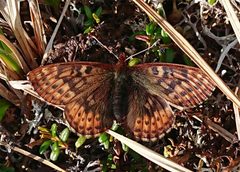
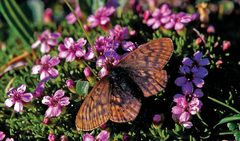
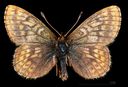
Pronunciation
How to pronounce Boloria improba: //bɔˈloʊriə ɪmˈproʊbə//
These audio files are automatically generated. While they are not always 100% accurate, they are a good starting point.
Images
Habitat
Alpine and tundra environments. In North America, associated with patches of Salix nivalis in isolated alpine of the San Juan Mountains, Colorado. Microhabitat requirements for the endangered B. i. acrocnema include slopes of 11°–31°, soil moisture content of 0.09–0.38 m³/m³, and herbaceous coverage of specific alpine plant including Salix nivalis, Geum rossii, Phacelia sericea, Noccaea fendleri, and Lewisia pygmaea.
Distribution
Holarctic distribution with fragmented . Europe: border region between Norway, Sweden, and Finland ( B. i. improbula). North America: northeastern Alaska and northwestern Canada (subspecies B. i. improba); isolated populations in southwestern Wyoming (B. i. harryi, Wind River Mountains) and southwestern Colorado (B. i. acrocnema, San Juan Mountains). Asia: Chukotka region of northeastern Russia.
Diet
Larvae in Europe probably feed on Polygonum viviparum. In North America, larvae feed on Salix arctica and Salix reticulata nivalis.
Ecological Role
The B. i. acrocnema is considered a indicator for alpine health.
Human Relevance
The B. i. acrocnema (Uncompahgre fritillary) was listed as federally endangered in the United States in 1991. Research on this subspecies has informed conservation planning for alpine threatened by climate change.
Sources and further reading
- BugGuide
- Wikipedia
- GBIF taxonomy match
- iNaturalist taxon
- NCBI Taxonomy
- Matan Shelomi: In the Era of #FakeNews...Predatory Journals | Bug Squad
- Funding from ScottishPower Foundation helps to restore vital habitat to encourage thriving natural ecosystem - Buglife Blog - Buglife
- Do Managed Burns in Grasslands Benefit Butterflies?
- New species of clearwing moth from Guyana discovered in Wales
- Exit Strategy: How Pupating Red Mason Bees Deal With "Misorientation" Inside Their Nests
- How Flashy Wings, UV Light, and Seasons All Play a Role in One Butterfly Species' Mating Rituals
- Microhabitat requirements of the uncompahgre fritillary butterfly (Boloria improba acrocnema) and climate change implications
- Genetic divergence and the Pleistocene history of the alpine butterflies Boloria improba (Nymphalidae) and the endangered Boloria acrocnema (Nymphalidae) in western North America