
Plebejus icarioides
Boisduval, 1852
Melissa blue, Fender's blue
Species Guides
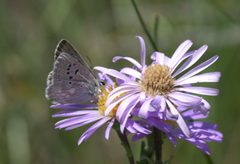
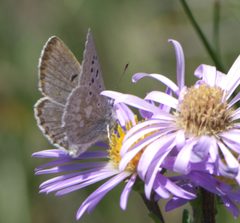
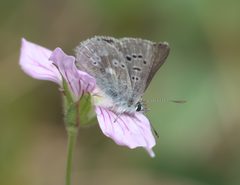
7Plebejus icarioides is a of lycaenid commonly known as the Melissa blue. The species has been observed colonizing alfalfa in the Great Basin region, representing a notable range expansion. One , P. icarioides fenderi (Fender's blue), is federally endangered in the United States and has been the focus of intensive conservation research. The species exhibits tending , with caterpillars producing sugar secretions that ants collect in exchange for protection from natural enemies.
Pronunciation
How to pronounce Plebejus icarioides: //plɛˈbiː.jəs ɪˌkæˈri.oʊˌaɪ.diz//
These audio files are automatically generated. While they are not always 100% accurate, they are a good starting point.
Images
Habitat
Native include prairie and grassland . The has demonstrated ability to colonize agricultural landscapes, specifically alfalfa fields in the Great Basin region. The endangered P. icarioides fenderi occurs in early-successional habitats that are maintained by periodic disturbance such as prescribed fire.
Distribution
Western North America, including the Great Basin region. The endangered P. icarioides fenderi is restricted to specific locations in Oregon and Washington.
Diet
Caterpillars feed on plants including native legumes and, in colonized areas, alfalfa (Medicago sativa). butterflies have been observed puddling on wet sand and soil to obtain minerals.
Host Associations
Life Cycle
Complete with , larva (caterpillar), pupa, and stages. Caterpillars produce silk webbing on plant leaves for shelter from sun while feeding.
Behavior
Ecological Role
As a herbivore, contributes to energy flow in prairie and grassland . The mutualistic relationship with ants represents an important ecological interaction. Serves as a research model for understanding range dynamics and of novel .
Human Relevance
The endangered P. icarioides fenderi has been a focus of intensive conservation efforts, with managed recovery programs increasing from fewer than 1,500 individuals in the 1990s to 25,000-30,000. Research on this has informed restoration techniques including prescribed fire management. The species' of alfalfa provides insights into agricultural impacts on populations and evolutionary to anthropogenic change.
Similar Taxa
- Plebejus acmonSimilar size and blue coloration; both occur in western North American
- Icaricia icarioidesSynonym; same under alternative generic classification
More Details
Conservation research
The Fender's blue (P. icarioides fenderi) has been extensively studied by Cheryl Schultz and colleagues at Washington State University Vancouver. Research has demonstrated that prescribed fire can improve quality and increase butterfly when properly timed, with optimal benefits observed two years post-burn. Studies have also shown that habitat quality supporting mutualistic correlates with increased butterfly production, likely due to higher larval survival.
Genetic research
Matt Forister and colleagues have investigated the genetic architecture underlying plant use in this , comparing using native hosts versus those that have colonized alfalfa. This research addresses questions about the evolution of diet breadth and to novel hosts in the Anthropocene.
Sources and further reading
- BugGuide
- GBIF taxonomy match
- Matt Forister: Melissa Blue Butterfly and Colonization of Alfalfa | Bug Squad
- Bug Eric: Mother (Nature's) Day in Madera Canyon
- A Look at the Science of Insect Conservation
- Saving endangered species with herbicides | Beetles In The Bush
- Factors associated with ant tending in Fender’s blue butterfly (Plebejus icarioides fenderi): Implications for habitat restoration and species recovery