
Plebejus melissa
(W.H. Edwards, 1873)
Melissa Blue
Species Guides
1- Plebejus melissa samuelis(Karner blue butterfly)
The Melissa Blue (Plebejus melissa) is a small in the Lycaenidae, native to western North America. This has been extensively studied for its of alfalfa as a novel plant, representing a well-documented case of host range expansion. The Karner blue (P. m. samuelis), described by Vladimir Nabokov, is a federally endangered restricted to oak savanna and pine barren in the upper Midwest.

Pronunciation
How to pronounce Plebejus melissa: //ˈplɛ.bɪ.dʒəs məˈlɪs.ə//
These audio files are automatically generated. While they are not always 100% accurate, they are a good starting point.
Identification
Distinguished from similar blues by combination of orange submarginal crescents on both wing surfaces and spotted (not banded) underside pattern. Acmon Blue (P. acmon) has more prominent orange band on hindwing underside and lacks extensive spotting. Arrowhead Blue (Glaucopsyche piasus) shows arrowhead-shaped spots rather than round spots. Silvery Blue (Glaucopsyche lygdamus) has unmarked or lightly marked underside without orange crescents. Karner blue requires careful examination of orange crescent extent and female blue scaling.
Images
Appearance
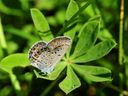
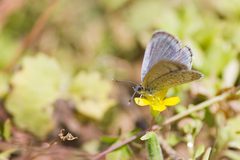
Small with wingspan typically 22-32 mm. Upper wing surface of males is iridescent blue with narrow dark borders; females are brownish with variable blue scaling. Underside of hindwing displays a distinctive pattern of black spots on gray-brown background, with orange marginal crescents. Forewing underside shows similar spotting pattern with submarginal band of orange crescents. are ringed with white. The Karner blue (samuelis) is distinguished by more extensive orange crescents on hindwing underside and reduced blue in females.
Habitat
Open including prairies, meadows, sagebrush steppe, and mountain foothills. The endangered Karner blue is restricted to oak savanna and pine barren with wild lupine (Lupinus perennis). Colonized agricultural landscapes where alfalfa is cultivated, particularly in the Great Basin region. Elevation range from sea level to montane zones, varying by region.
Distribution
Western North America from southern Canada (British Columbia, Alberta, Saskatchewan) through the western United States to northern Mexico. Disjunct in the upper Midwest (Great Lakes region) represent the endangered Karner blue . Has expanded eastward in association with alfalfa .
Seasonality
Multiple per year in most of range, typically May through September depending on elevation and latitude. Karner blue has two broods synchronized with wild lupine : first brood May-June, second brood July-August. period shorter at higher elevations and northern latitudes.
Diet
Larvae feed on legumes (Fabaceae), primarily Lupinus in native . Has colonized alfalfa (Medicago sativa) as a novel plant, with in the Great Basin now specializing on this agricultural crop. sip nectar from various flowers and engage in puddling to obtain minerals from moist soil.
Host Associations
- Lupinus - larval plantprimary native , especially L. perennis for Karner blue
- Medicago sativa - larval plantcolonized novel , now primary in some agricultural
- Astragalus - larval plantnative in western range
- Oxytropis - larval plantnative in northern range
Life Cycle
Complete with four stages. laid singly on plant leaves or flowers. Larvae feed on host plant tissues, tended by Formica ants in mutualistic relationship; caterpillars produce sugar-rich secretions consumed by ants, which provide protection from and . occurs in leaf litter or soil near host plant. stage varies: Karner blue overwinters as egg, other may overwinter as partially grown larva. Multiple per year in most locations.
Behavior
Males defend territories near plants and water sources. engage in puddling, congregating at moist soil or sand to extract minerals, particularly sodium, which males transfer to females during mating. Larval- mutualism with Formica ants is well-documented; ants actively protect caterpillars and in return collect secretions from specialized glands. Adults have relatively weak, fluttering typical of small lycaenids.
Ecological Role
of various flowering plants. Larval- mutualism represents a classic example of interspecies cooperation. As a herbivore on legumes, influences plant dynamics in prairie and savanna . Serves as prey for birds, spiders, and insect . The Karner blue is a flagship for oak savanna and pine barren conservation.
Human Relevance
Karner blue (P. m. samuelis) is federally endangered in the United States; recovery efforts focus on restoration and wild lupine management. Agricultural pest in alfalfa-growing regions where larval feeding reduces crop quality. Subject of extensive research on range expansion and evolutionary to novel hosts. Popular with watchers and photographers. Nabokov's taxonomic work on this contributed to his literary reputation for .
Similar Taxa
- Plebejus acmonOverlapping range and similar size; distinguished by more prominent continuous orange band on hindwing underside versus spotted pattern of P. melissa
- Glaucopsyche piasusSimilar blue coloration and ; arrowhead-shaped spots on underside versus round spots of P. melissa
- Glaucopsyche lygdamusSilvery blue coloration; underside lacks orange crescents and has minimal spotting compared to P. melissa
- Icaricia icarioidesBoisduval's blue has more extensive blue on female upperside and different underside pattern with more uniform gray background
More Details
Taxonomic history
Originally described as Lycaena melissa by W.H. Edwards in 1873. Vladimir Nabokov, the novelist and lepidopterist, described the Karner blue as Lycaeides melissa samuelis in 1944 based on specimens from Karner, New York. The has undergone repeated generic reclassification between Lycaeides and Plebejus, with current treatments favoring Plebejus.
Research significance
of alfalfa by P. melissa represents one of the best-documented cases of contemporary range expansion in butterflies. Research by Matt Forister and colleagues has revealed the genetic architecture underlying this host shift, including genomic regions associated with performance on novel hosts. This system serves as a model for understanding how herbivorous insects adapt to agricultural landscapes.
Sources and further reading
- BugGuide
- GBIF taxonomy match
- iNaturalist taxon
- NCBI Taxonomy
- Matt Forister: Melissa Blue Butterfly and Colonization of Alfalfa | Bug Squad
- Attracting Pollinators to Your Garden | Bug Squad
- How One Entomologist Brings a Passion for Science Back to Her Home Country
- How a Colorado Extension Entomologist Wrangles Pests and Protects Biodiversity
- From the Lab to the Legislature and Living Room: Science Needs Storytellers
- Bug Eric: Mother (Nature's) Day in Madera Canyon