
Plebejus melissa samuelis
(Nabokov, 1944)
Karner blue butterfly
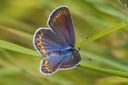
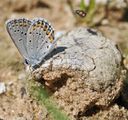
Plebejus melissa samuelis, commonly known as the Karner blue , is a federally endangered first described by Vladimir Nabokov in 1944 from Karner, New York. It is highly specialized, with larvae feeding exclusively on wild lupine (Lupinus perennis) and inhabiting dry sandy barrens . The subspecies produces two annually and has become a flagship for conservation efforts, particularly in Wisconsin where a pioneering statewide Conservation Plan was developed.

Pronunciation
How to pronounce Plebejus melissa samuelis: //ˈplɛbɛdʒəs məˈlɪsə səˈmjuːlɪs//
These audio files are automatically generated. While they are not always 100% accurate, they are a good starting point.
Images
Habitat
Dry, sandy patches in oak savanna-like landscapes called 'barrens,' characterized by scrub oak and jack pine. These occur in the 'tension zone' where mixed coniferous forest meets hardwood forest. Wild lupine plants must be present as the exclusive larval food source.
Distribution
Upper Midwest United States: Wisconsin (largest remaining ), Minnesota, Michigan, Indiana, Ohio. Disjunct populations survive in New York and New Hampshire. Historical range included approximately 32 million acres of barrens; less than 8 million acres remain.
Seasonality
First- emerge late May to early June, with second-generation adults appearing in July. First-generation caterpillars hatch in April from deposited the previous summer, pupate by mid-May. Second-generation eggs hatch within a week of deposition and complete development to adults by July. Eggs from second generation overwinter until the following spring.
Diet
Larva feeds exclusively on leaves of wild lupine (Lupinus perennis). have been observed nectaring on flowers, though specific nectar sources are not documented in the provided sources.
Host Associations
- Lupinus perennis - larval food plantexclusive ; larvae feed only on leaves
Life Cycle
(two per year). First generation: hatch in April, caterpillars feed on lupine, pupate by mid-May, emerge late May to early June, mate and deposit eggs by end of June. Second generation: eggs hatch within one week, caterpillars develop rapidly, adults emerge in July, mate and deposit eggs that overwinter until the following spring.
Behavior
disperse between patches of lupine, linking small local into metapopulations. allows across patches that may be separated by non-habitat areas.
Ecological Role
of barrens flora. Serves as prey for birds and other . Acts as an for healthy barrens , which support high biodiversity due to their position in the tension zone between northern and southern ranges.
Human Relevance
Federally listed since 1992. Subject of the first comprehensive statewide Conservation Plan in the United States, developed in Wisconsin beginning in 1992. The HCP model has been praised by the U.S. Fish and Wildlife Service as a template for endangered species conservation. use limitation areas (PULAs) have been established to protect remaining . Volunteer programs for recovery exist in multiple states.
Similar Taxa
- Plebejus melissa (Melissa blue)Wider-ranging from which P. m. samuelis was described as a ; differs in specificity and distribution
- Lycaeides idasRelated lycaenid with similar appearance; distinguished by preferences and distribution
More Details
Conservation History
First described by novelist Vladimir Nabokov in 1944. By 1992, only 1% of the original remained, prompting federal listing. The Wisconsin Conservation Plan, approved in 1998 after six years of development, was the first statewide HCP covering multiple agencies and private partners under a single incidental take permit. This approach addressed conflicts between conservation and economic activities including forestry, agriculture, and development.
Metapopulation Dynamics
Management focuses on metapopulations covering at least 25 acres with 3-5 subpopulations, rather than isolated small patches. Larger management units (>640 acres, >6,000 individuals) allow conservation to address landscape- . This approach acknowledges that butterflies do not recognize property boundaries and that natural disturbance regimes (fire, browsing, storms) historically maintained barrens .
Climate Change Implications
The tension zone is expected to shift northward with climate warming. Conservation management is developing strategies to create habitat stepping stones to facilitate range shifts for the Karner blue and other barrens-associated .
Sources and further reading
- BugGuide
- GBIF taxonomy match
- NCBI Taxonomy
- Matt Forister: Melissa Blue Butterfly and Colonization of Alfalfa | Bug Squad
- Attracting Pollinators to Your Garden | Bug Squad
- Wisconsin Butterfly Conservation Program Could Be a Model for Future Efforts
- A Brief Guide to Pesticide Mitigations, Label Changes to Protect Endangered Species
- Bug Eric: Ok, Save Some Bugs
- Bug Eric: November 2017