
Plebejus acmon
Westwood, 1851
Acmon Blue
Plebejus acmon, commonly known as the Acmon Blue, is a small in the Lycaenidae. It is found across western North America and is frequently encountered in diverse from lowland areas to montane regions. The is known to utilize various lupine species and other legumes as larval plants. are active spring through fall depending on elevation and region, with multiple produced annually in warmer areas.
Pronunciation
How to pronounce Plebejus acmon: //ˈpliːbɛjəs ˈækmɒn//
These audio files are automatically generated. While they are not always 100% accurate, they are a good starting point.
Identification
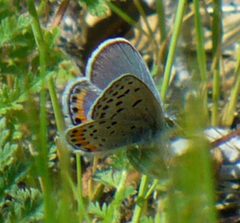
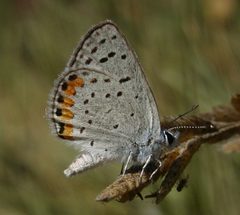
Distinguished from similar blues by the combination of orange marginal spots on the hindwing underside and the specific pattern of black spotting. Males are readily identified by the bright blue upper wing surface. Females may be confused with other female blues but show more extensive blue at the wing bases than most. Genitalia examination may be required for definitive separation from the closely related Melissa Blue where ranges overlap.
Images
Appearance
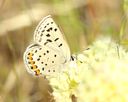
Small with wingspan typically under 35mm. Upper wing surfaces of males are iridescent blue with narrow dark borders; females are brown with blue basal areas. Undersides are grayish with small black spots and orange marginal markings on hindwings. The closely resembles the related Melissa Blue (Plebejus melissa) and Spring Azure (Celastrina echo) in general appearance.
Habitat
Occurs in diverse open including grasslands, meadows, chaparral, forest clearings, and riparian areas. Found from sea level to montane elevations. plant availability, particularly lupines and other native legumes, is a key habitat requirement.
Distribution
Western North America from southern British Columbia through Washington, Oregon, and California, extending eastward through the Great Basin to the Rocky Mountains and south into Arizona, New Mexico, and northern Mexico. Absent from the humid Pacific Northwest coastal forests.
Seasonality
are active from March through November depending on latitude and elevation. Multiple occur in warmer, lower-elevation areas; single or partial second broods at higher elevations or northern latitudes. Peak varies regionally, typically April-June and August-September in California.
Diet
Larval plants include various Lupinus (lupines), Lotus crassifolius (including variety otayensis), and other native legumes. nectar at a variety of flowers including Eriogonum (buckwheat), asters, and other composite flowers.
Host Associations
- Lupinus - larval plantMultiple native lupine including L. albifrons, L. arboreus, L. latifolius, L. polyphyllus, L. propinquus, L. sericatus
- Lotus crassifolius - larval plantVariety otayensis specifically noted for southern California
- Eriogonum - nectar sourceCalifornia buckwheat important nectar source
Life Cycle
Complete with , larva, pupa, and stages. Larvae feed on plant foliage and flowers. occurs in leaf litter or soil. Development rate varies with temperature; multiple per year in favorable climates. stage varies by , likely as pupae or partially grown larvae in most areas.
Behavior
are rapid, low fliers that frequently perch on low vegetation with wings closed. Males establish and defend territories in areas with plants, engaging in aerial pursuits of intruding males. Adults visit wet soil and sand for puddling , particularly males seeking minerals. Both sexes nectar at flowers.
Ecological Role
of various native plants during nectar feeding. Larval herbivore on native legumes, potentially contributing to nutrient cycling in grassland and chaparral . Prey for various and vertebrate .
Human Relevance
Subject of monitoring programs and citizen science observations. Occasionally referenced in conservation planning for restoration. Not a significant agricultural pest.
Similar Taxa
- Plebejus melissaMelissa Blue overlaps in range and is nearly identical in appearance; separation often requires examination of genitalia or detailed wing pattern analysis
- Celastrina echoEcho Spring Azure similar in size and blue coloration but lacks orange marginal spots on hindwing underside and has different plant associations
- Glaucopsyche lygdamusSilvery Blue similar in size and but has more extensive silvery-blue scaling and different underside pattern
More Details
Taxonomic Note
The Acmon Blue has been variously treated under the Plebejus, Icaricia, and Lycaeides by different authorities. Current treatments generally place it in Plebejus, though some regional works may use alternative generic assignments.
Conservation Status
Not currently considered threatened rangewide, though local may be affected by loss and plant that displace native plants. Climate change impacts on montane populations are a potential concern.
Sources and further reading
- BugGuide
- GBIF taxonomy match
- A Close Call | Bug Squad
- A Summit to Save the Butterflies | Bug Squad
- Matt Forister: Melissa Blue Butterfly and Colonization of Alfalfa | Bug Squad
- Migrating Monarchs Lovin' the Tithonia | Bug Squad
- Fluttering Along on a Butterfly Tour | Bug Squad
- Bug Eric: Mother (Nature's) Day in Madera Canyon