
Euphilotes rita
(Barnes & McDunnough, 1916)
Rita's Blue, rita blue, desert buckwheat blue
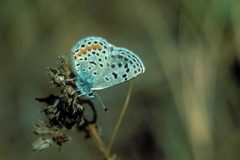
Euphilotes rita is a small lycaenid native to the southwestern United States and northern Mexico. are active from July through late September, with a single per year. The exhibits strong ecological specialization on wild buckwheat (Eriogonum species) throughout its . Larvae are tended by ants, a characteristic mutualism within the Polyommatinae.
Pronunciation
How to pronounce Euphilotes rita: //juːˈfɪloʊtiːz ˈriːtə//
These audio files are automatically generated. While they are not always 100% accurate, they are a good starting point.
Identification
Distinguished from other Euphilotes by geographic range and plant associations. Euphilotes enoptes (square-spotted blue) occurs in overlapping range but typically uses different Eriogonum hosts; precise identification often requires examination of genitalia or larval host plant. Euphilotes battoides (Boisduval's blue) has more extensive dark markings on underwings. period and preferences can aid separation from .
Images
Habitat
Juniper-pinyon woodlands, sand dunes, oak woodland, and prairie grasslands. Strongly associated with areas supporting wild buckwheat (Eriogonum) plants. Elevational range spans from low desert flats to montane grasslands.
Distribution
Wyoming, Colorado, Arizona, New Mexico, and northern Mexico. Distribution closely tracks that of its primary plants in the Eriogonum.
Seasonality
active from July to late September. Single per year ().
Diet
Larvae feed on flowers and fruits of wild Eriogonum , specifically Eriogonum effusum, E. flavum, E. leptocladon, E. racemosum, and E. wrightii. feed on nectar from plants and seep-willow (Baccharis salicifolia).
Host Associations
- Eriogonum effusum - larval food plantflowers and fruits consumed
- Eriogonum flavum - larval food plantflowers and fruits consumed
- Eriogonum leptocladon - larval food plantflowers and fruits consumed
- Eriogonum racemosum - larval food plantflowers and fruits consumed
- Eriogonum wrightii - larval food plantflowers and fruits consumed
- Baccharis salicifolia - nectar sourceseep-willow
Life Cycle
Complete with four stages: , larva, pupa, . Eggs laid on plant flowers or fruits. Larvae feed on reproductive structures of Eriogonum. occurs in soil or leaf litter. Single per year with adults emerging mid-summer.
Behavior
Ecological Role
of Eriogonum through nectar feeding. Larvae function as primary consumers of buckwheat reproductive tissues. mutualism represents a classic example of trophic facilitation in lycaenid butterflies.
Human Relevance
No significant economic importance. Subject of conservation interest due to specificity and potential vulnerability of Eriogonum plants to land use change.
Similar Taxa
- Euphilotes enoptesOverlapping range; distinguished by plant preferences and subtle wing pattern differences
- Euphilotes battoidesSimilar size and coloration; E. battoides has more extensive dark underwing markings
- Euphilotes ancillaSympatric in parts of range; requires genitalic examination for certain identification
More Details
Subspecies
Four recognized : E. r. rita (nominate), E. r. coloradensis Mattoni 1966, E. r. mattoni Shields 1975, and E. r. emmeli Shields 1975. Subspecies primarily distinguished by geographic distribution and minor wing pattern variations.
Conservation Status
Not formally listed as threatened, but specificity on Eriogonum plants makes vulnerable to habitat loss and fragmentation. Climate change may affect phenological synchrony with host plants.
Taxonomic History
Originally described as Lycaena rita by Barnes & McDunnough in 1916; later transferred to Euphilotes.
Sources and further reading
- BugGuide
- Wikipedia
- GBIF taxonomy match
- iNaturalist taxon
- NCBI Taxonomy
- Catalogue of Life
- Our Story Begins with Eight Monarch Caterpillars in the Dead of Winter | Bug Squad
- Bugs Share Spotlight with Pigs, Polar Bears and Pigeons: ACE Awards | Bug Squad
- Once Upon a Monarch... | Bug Squad
- Bug Eric: Wasp Wednesday: Neamblyjoppa?
- 2018 Arizona Insect Collecting Trip “iReport” | Beetles In The Bush
- Platystomatidae | Beetles In The Bush