
Erynnis propertius
(Scudder & Burgess, 1870)
Propertius duskywing, Propertius Dusky-Wing
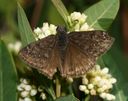
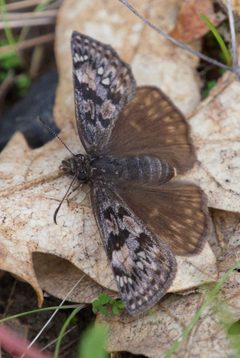
Erynnis propertius, commonly known as the Propertius duskywing, is a in the Hesperiidae. It occurs along the Pacific coast of North America from southern British Columbia to Baja California Norte and is one of the most frequently encountered skippers in California. The has been studied at the northern edge of its range, where peripheral loss threats but may contribute to poleward range expansion under warming conditions.

Pronunciation
How to pronounce Erynnis propertius: //ɛˈrɪn.nɪs prəˈpɜːr.ti.əs//
These audio files are automatically generated. While they are not always 100% accurate, they are a good starting point.
Identification
Difficult to distinguish from other Erynnis based on view alone. Identification typically requires examination of wing patterns and knowledge of period and geographic location. In California's Central Valley, Art Shapiro's long-term monitoring indicates it is regularly recorded in late January, earlier than many other duskywing species. Similar species include Erynnis tristis (Mournful Duskywing) and other Pacific coast Erynnis; precise identification often requires close examination of wing pattern details and context.
Images
Habitat
Occurs in diverse along the Pacific Slope including oak woodlands, chaparral, coastal scrub, and adjacent grasslands. Northern peripheral occupy isolated habitat patches threatened by loss and fragmentation. At the northern range edge, populations are associated with warmer microclimates and early spring conditions.
Distribution
Pacific coast of North America from southern British Columbia south through Washington, Oregon, and California to Baja California Norte, Mexico. Core occur throughout California; range becomes increasingly fragmented toward northern and southern peripheries.
Seasonality
fly in early spring in California's Central Valley, with records as early as January 22 (1990) and January 25 (2014) at Gates Canyon, Vacaville. responds to spring daytime mean temperatures, with earlier in warmer springs. Multiple likely in southern portions of range.
Life Cycle
larval growth rate does not vary directly with temperature. All larval instars have been described; larvae feed on oak (Quercus), though specific associations for this species require verification from primary literature.
Behavior
are rapid, darting fliers typical of skippers. activity begins early in the year compared to many co-occurring . patterns remain stable across years in broad regions at the northern range limit.
Ecological Role
Peripheral at the northern range edge may play an important role in potential poleward range expansion as regional temperatures increase. As a skipper, likely contribute to pollination of early spring flowers. Larval feeding on oaks represents a connection to tree in western North American .
Human Relevance
Subject of long-term monitoring by researchers including Art Shapiro in California's Central Valley, contributing to understanding of responses to climate variation and drought. One of the most commonly observed skippers in California, making it accessible for citizen science and education.
Similar Taxa
- Erynnis tristisSimilar dark coloration and size; occurs in overlapping range in western North America. Distinguished by wing pattern details and period.
- Erynnis horatius / E. juvenalisEastern duskywings with similar appearance; E. propertius distinguished by western distribution and earlier spring in California.
- Erynnis brizoSleepy Duskywing occurs at higher elevations and in oak ; E. propertius more widespread at lower elevations along Pacific Slope.
More Details
Climate sensitivity
Research at the northern range edge indicates and timing of key resources respond to average daytime temperatures in spring, making this a useful indicator of climate effects on insect .
Research importance
The has been intensively studied at range peripheries due to its potential role in understanding climate-driven range shifts and the conservation value of isolated peripheral .
Sources and further reading
- BugGuide
- Wikipedia
- GBIF taxonomy match
- iNaturalist taxon
- Catalogue of Life
- 'Battus philenor! Battus philenor!' | Bug Squad
- Oedemeridae | Beetles In The Bush
- Bug Eric: Spring (Butterfly) Beauties
- Grassland butterflies: important indicators of the state of nature
- Biology of larvae and adults ofErynnis propertiusat the northern edge of its range