
Erynnis brizo
Boisduval & Le Conte, 1832
Sleepy Duskywing, Banded Oak Duskywing
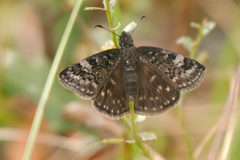
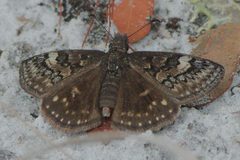
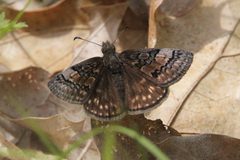
Erynnis brizo is a in the Hesperiidae, found throughout North America. are commonly confused with E. juvenalis and E. lucilius. The is listed as threatened in Connecticut and Maine. Larvae feed on scrub oaks, while adults nectar from heath family flowers and other sources.
Pronunciation
How to pronounce Erynnis brizo: //ɛˈrɪnɪs ˈbrɪzoʊ//
These audio files are automatically generated. While they are not always 100% accurate, they are a good starting point.
Identification
Distinguished from similar Erynnis by continuous bluish-brown spots on the upper forewing (not banded or spotted patterns seen in E. juvenalis). examination may be necessary for definitive separation from E. juvenalis and E. lucilius.
Images
Habitat
Occupies oak-pine barrens, cut-over forest, and forest edges. Frequently observed near roads, train tracks, and towns where oaks are present.
Distribution
Occurs throughout North America. Documented from Canada (Manitoba, Saskatchewan, Vermont) through the United States and into Middle America.
Seasonality
active in early spring; has been observed as early as March 4 in Arizona. Single-brooded in northern portions of range.
Diet
Larvae feed on scrub oak (Quercus ilicifolia) and other shrubby oaks. consume nectar from flowers of heaths (Ericaceae) including wild azalea and blueberry, as well as blackberry and dandelion.
Host Associations
- Quercus ilicifolia - larval scrub oak
- Quercus - larval other shrubby oaks
- Ericaceae - nectar sourcewild azalea, blueberry
- Rubus - nectar sourceblackberry
- Taraxacum - nectar sourcedandelion
Life Cycle
Complete with , larva, pupa, and stages. Single per year in northern range; larval stage feeds on oak foliage.
Behavior
perch with wings partially open. Rapid, darting typical of skippers. Males defend territories and pursue intruders.
Ecological Role
Larval herbivore on oaks; of early spring flowers. Serves as prey for birds and other .
Human Relevance
Subject of conservation concern; listed as threatened in Connecticut and Maine. Occasionally encountered in urban-edge . Misidentification with related complicates monitoring.
Similar Taxa
- Erynnis juvenalisSimilar size and coloration; distinguished by forewing spot pattern and presence of one or two dots on hindwing in E. juvenalis
- Erynnis luciliusOverlapping range and appearance; requires close examination of wing markings for separation
- Erynnis funeralisSimilar (Funereal Duskywing) and ; distinguished by white hindwing border
Misconceptions
The "Sleepy Duskywing" does not indicate lethargy; the is as active as other skippers. The name "banded oak duskywing" refers to the spot pattern, not a taxonomic distinction from other oak-feeding Erynnis.
More Details
Conservation Status
Listed as threatened in Connecticut and Maine; may be vulnerable to oak loss and fragmentation.
Taxonomic History
Originally described as Thanaos brizo by Boisduval & Le Conte in 1832 (or 1837 in some sources).