
Erynnis funeralis
(Scudder & Burgess, 1870)
Funereal Duskywing
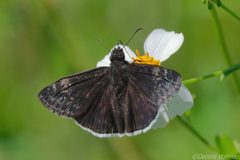
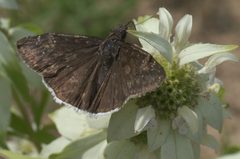
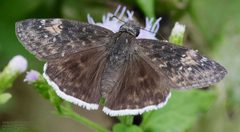
Erynnis funeralis, commonly known as the funereal duskywing, is a medium-sized in the Hesperiidae. It ranges from the southwestern United States through Mexico and Central America to South America. The is distinguished from similar duskywings by its narrow forewing with a white fringe on the hindwing. are active from February to October, with larvae feeding on various leguminous plants.
Pronunciation
How to pronounce Erynnis funeralis: //ɛˈrɪn.nɪs fjuːˈnɛ.rə.lɪs//
These audio files are automatically generated. While they are not always 100% accurate, they are a good starting point.
Identification
Distinguished from the similar mournful duskywing (Erynnis tristis) by narrower forewings with a light brown patch along the outer edge. The white fringe on the hindwing is a key field mark. From other Erynnis , the combination of narrow forewing, dark ground color, and prominent white hindwing fringe is diagnostic. Males have a costal fold on the forewing; females lack this fold and are generally slightly larger.
Images
Appearance
Wingspan 34–45 mm. Forewings narrow, predominantly black with brown markings and a light brown patch along the outer edge. Hindwings black with brown areas and a conspicuous white fringe along the outer margin. Overall dark coloration with contrasting pale fringe creates a distinctive 'funereal' appearance.
Habitat
Open, sunny areas including prairies, glades, woodland edges, and disturbed . Often associated with leguminous plants. In the southwestern United States, found in desert and semi-arid environments including riparian corridors and urban gardens.
Distribution
Native range extends from southern California, Arizona, New Mexico, and Texas south through Mexico and Central America to Argentina and Chile. Strays documented north to northern Illinois, northeastern Nebraska, central Colorado, southern Nevada, and central California. GBIF records confirm presence in Middle America, North America, and South America.
Seasonality
observed from February to October in the United States, with peak activity varying by latitude. Multiple per year in warmer portions of range. In southern Arizona and similar climates, active nearly year-round with reduced winter activity.
Diet
Larvae feed on various leguminous plants including Medicago sativa (alfalfa), Medicago hispida, Robinia neomexicana, Lotus scoparius, Olneya tesota, Vicia , and Acmispon. feed on flower nectar from diverse blooming plants.
Host Associations
- Medicago sativa - larval primary , alfalfa
- Robinia neomexicana - larval New Mexico locust
- Medicago hispida - larval
- Lotus scoparius - larval deerweed
- Olneya tesota - larval ironwood
- Vicia - larval vetches
- Acmispon - larval deerweeds
Life Cycle
Complete with , larva, pupa, and stages. Larvae have black and green body with yellow hairs and yellow markings. occurs in silken shelters on or near plants. Multiple per year in most of range.
Behavior
Fast, darting typical of duskywing skippers. perch with wings partially open, basking in sunlight. Males establish territories and perch on prominent vegetation to await females. Both sexes visit flowers for nectar, with adults often remaining near larval plant stands.
Ecological Role
Larval herbivore on leguminous plants; contributes to nutrient cycling in prairie and semi-arid . , visiting diverse flowering plants for nectar. Serves as prey for birds, spiders, and other .
Human Relevance
Occasional minor pest in alfalfa fields due to larval feeding. More commonly appreciated by watchers and photographers. Presence in urban gardens and parks makes it accessible for public engagement with native .
Similar Taxa
- Erynnis tristisMournful duskywing has broader forewings and lacks the distinct white hindwing fringe; forewing lacks the light brown outer edge patch
- Erynnis horatiusHorace's duskywing has more extensive pale markings on forewing and different season in much of range
- Erynnis juvenalisJuvenal's duskywing has hindwing spots not present in E. funeralis and more restricted early-spring period
More Details
Nomenclature
The epithet 'funeralis' refers to the dark, somber coloration of the wings, not to any association with death or decay in its .
Sources and further reading
- BugGuide
- Wikipedia
- GBIF taxonomy match
- iNaturalist taxon
- Catalogue of Life
- Celebrating National Moth Night at the Bohart Museum of Entomology | Bug Squad
- Ready for Moth Night at UC Davis? | Bug Squad
- 'Battus philenor! Battus philenor!' | Bug Squad
- Bug Eric: Spring (Butterfly) Beauties
- Oedemeridae | Beetles In The Bush