
Erynnis afranius
(Lintner, 1878)
Afranius Duskywing, Bald Duskywing
Erynnis afranius, commonly known as the Afranius duskywing or bald duskywing, is a in the Hesperiidae. It occurs across a broad range from northern Mexico through the central United States to southern Canada. The is , with two flying from mid-May to late August. Larvae feed on leguminous plants including Lupinus, Lotus, and Thermopsis species.
Pronunciation
How to pronounce Erynnis afranius: /eˈryn.nis aˈfra.ni.us/
These audio files are automatically generated. While they are not always 100% accurate, they are a good starting point.
Identification
Erynnis afranius is one of several duskywing skippers that can be difficult to distinguish without close examination. The Erynnis is notoriously challenging, with often requiring observation of wing patterns, period, or plant association for reliable identification. E. afranius may be separated from similar species by its specific geographic range, flight pattern (mid-May to late August), and association with prairie and grassland . Detailed wing pattern comparisons with congeneric species such as E. horatius, E. juvenalis, or E. tages would be necessary for field identification.
Images
Appearance
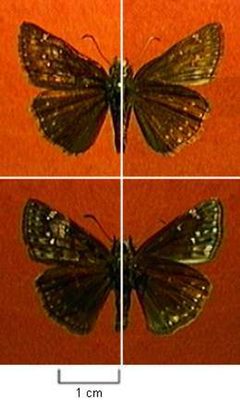
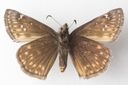
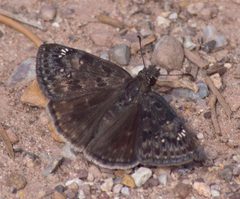
Wingspan 25–31 mm. A small, dark-colored skipper typical of the Erynnis. Duskywings are generally characterized by dark brown to blackish wings with small pale spots or bands, though specific pattern details for E. afranius require closer examination.
Habitat
Prairie and grassland . Associated with open areas supporting larval plants in the legume .
Distribution
Northern Mexico through the central United States to southern Canada. Recorded from the Canadian provinces of Alberta, Saskatchewan, and Manitoba. Distribution records also indicate presence in Middle America and North America broadly.
Seasonality
Two per year, flying from mid-May to late August. This pattern distinguishes it from some with different periods.
Diet
Larvae feed on Lupinus , Lotus species, and Thermopsis rhombifolia (leguminous plants). feeding habits not specified in available sources.
Host Associations
- Lupinus - larval multiple
- Lotus - larval multiple
- Thermopsis rhombifolia - larval
Life Cycle
, with two per year. Complete with , larva, pupa, and stages. Specific details of site or stage not documented in available sources.
Ecological Role
Larval herbivore on leguminous plants. likely serves as . As with other grassland butterflies, may serve as an for quality in prairie .
Similar Taxa
- Erynnis horatiusSimilar dark duskywing appearance; flies through summer rather than limited to spring
- Erynnis juvenalisSimilar dark duskywing appearance; flies only in early spring and has distinctive hindwing spots
- Erynnis tagesSimilar dark duskywing appearance; European showing decline in grassland
More Details
Taxonomic note
Erynnis afranius is classified in the Pyrginae within Hesperiidae. The Erynnis contains numerous cryptic that present identification challenges.
Monitoring context
While not specifically mentioned in the German Grassland Index study, Erynnis including E. tages are recognized as indicators of grassland quality. The broader is relevant to butterfly monitoring programs in North America and Europe.