
Ephyriades brunnea
(Herrich-Schäffer, 1865)
Florida Duskywing, Florida duskywing skipper
Ephyriades brunnea is a to South Florida, restricted to pine rockland . The has experienced noticeable declines in recent years and is listed as a Species of Greatest Conservation Need in Florida. have a wingspan of approximately 48 mm and exhibit in wing pattern. Larvae feed exclusively on Barbados cherry (Malpighia emarginata), while adults nectar on wild coffee and other flowering plants.
Pronunciation
How to pronounce Ephyriades brunnea: //ɛˈfɪri.eɪdiːz ˈbrʌniːə//
These audio files are automatically generated. While they are not always 100% accurate, they are a good starting point.
Identification
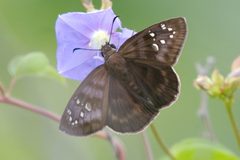
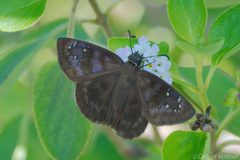
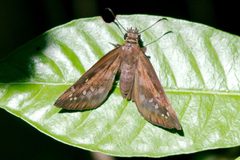
Distinguished from similar duskywing skippers by combination of: dark brown forewing with purplish sheen in fresh specimens; circular arrangement of white transparent spots near forewing apex (more numerous in females); broad lighter brown margin on hindwing. Female with larger size, more numerous and larger white spots, and dark mottling with dark outer margins. Larvae identifiable by translucent green body, black with orange lateral patches, and yellow-striped dorsal pattern.
Images
Appearance
Medium-sized skipper with wingspan approximately 48 mm (1 7/8 inches). forewing dark brown with purplish sheen when fresh, bearing circle of white transparent spots near apex; hindwing with broad lighter brown margin. Females larger than males with more numerous and larger dorsal spots, brown ground color with dark mottling and dark outer margins. surface not described in sources. Caterpillar small, translucent green with black bearing orange patches on sides and upper ; dorsum with dark line bordered in yellow, yellow lines along sides, and multiple small yellow spots.
Habitat
Pine rockland in South Florida. These are fire-maintained, open- forests on limestone substrate characterized by slash pine canopy with diverse understory of grasses and shrubs.
Distribution
to South Florida, United States. Historical range within the pine rockland of southern Florida peninsula.
Seasonality
activity period not explicitly documented in sources; likely year-round or multi-brooded given tropical/subtropical climate of South Florida, but specific times undetermined.
Diet
Larvae are feeders on Barbados cherry (Malpighia emarginata). nectar on wild coffee (Psychotria ligustrifolia), Bidens alba, Croton granduosus, and involucrata.
Host Associations
- Malpighia emarginata - larval food plantBarbados cherry; exclusive larval
- Psychotria ligustrifolia - nectar sourcewild coffee; noted as important nectar source
- Bidens alba - nectar source
- Croton granduosus - nectar source
- Lantana involucrata - nectar source
Life Cycle
Complete with , larva, pupa, and stages. Larval development occurs on Barbados cherry. details not documented. Two of parasitic are known to parasitize larvae. duration and number of per year not explicitly stated.
Ecological Role
of nectar plants. Larvae serve as for parasitic . Specialized herbivore in pine rockland .
Human Relevance
of conservation concern due to loss and fragmentation of pine rocklands. Listed as Species of Greatest Conservation Need (SGCN) in Florida's State Wildlife Action Plan. Considered threatened by climate change, particularly sea level rise affecting its specialized habitat. Subject of genetic diversity studies showing moderate diversity despite small sizes.
Similar Taxa
- Other Ephyriades speciesCongeneric skippers with similar duskywing ; distinguished by wing pattern details and geographic distribution
- Other Pyrginae skippersSimilar overall skipper ; E. brunnea distinguished by specific spot pattern on forewing and South Florida
More Details
Conservation Status
Listed as of Greatest Conservation Need (SGCN) in Florida's State Wildlife Action Plan. have noticeably declined in recent years. specialized and fragmented; threatened by sea level rise. Exhibits moderate genetic diversity despite small population sizes. Not infected by bacteria.
Taxonomic History
Originally described as Nisodiades brunnea by Herrich-Schäffer in 1865 (or 1864 in some sources). Transferred to Ephyriades.