
Anatrytone logan
(Edwards, 1863)
Delaware Skipper
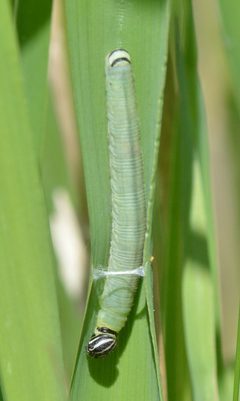
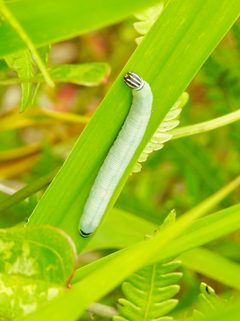
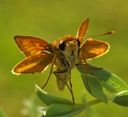
Anatrytone logan, commonly known as the Delaware skipper, is a North American grass in the Hesperiidae. It ranges from the southern Canadian Prairies and southern Ontario through the midwestern and eastern United States. The exhibits sexual monomorphism in coloration, with both sexes displaying yellow-orange wings with black borders and dark brown venation. It is multivoltine in warmer regions and in northern areas, with larval development dependent on native grasses.
Pronunciation
How to pronounce Anatrytone logan: /ˌænəˈtraɪtoʊn ˈloʊɡən/
These audio files are automatically generated. While they are not always 100% accurate, they are a good starting point.
Identification
The Delaware skipper can be distinguished from similar orange skippers by its broad black wing borders and the nearly unmarked yellowish-orange underside. The absence of spots or bands on the wing surface separates it from many and related grass skippers such as Ancyloxypha numitor (least skipper), which has more extensive dark markings below. The dark brown venation is prominent on both wing surfaces. Specimens from northern may appear slightly smaller and darker.
Images
Habitat
Occupies moist including marshes, wet meadows, prairie swales, and damp residential landscaping. Associated with areas supporting native warm-season grasses required for larval development. Tolerates disturbed and semi-urban environments where grasses persist.
Distribution
North American ranging from southern Canadian Prairies and southern Ontario southward through the midwestern and eastern United States. Records include Vermont and surrounding regions. Absent from western North America.
Seasonality
Active February through October in warmer southern regions with multiple produced annually. Restricted to a single summer brood in northern portions of range. timed with flowering of nectar sources.
Diet
feed on nectar from flowers, particularly pink and white including milkweeds (Asclepias), mountain mints (Pycnanthemum), and thistles (Cirsium). Larvae feed on grasses including big bluestem (Andropogon gerardii) and switchgrass (Panicum virgatum).
Host Associations
- Andropogon gerardii - larval Big bluestem, native prairie grass
- Panicum virgatum - larval Switchgrass, native warm-season grass
Life Cycle
Multivoltine in southern range (multiple February–October); in north (single summer brood). Complete with , larval, pupal, and stages. Larval development occurs on grasses; site not well documented but presumed to be in grass litter or loose soil.
Behavior
are and visit flowers for nectar. is rapid and low, typical of grass skippers. Males likely perch to await females, though specific territorial not documented. Multiple in warm climates suggest extended reproductive season with overlapping .
Ecological Role
Human Relevance
Occasionally observed in gardens and residential areas where moist conditions and native grasses are maintained. Not considered economically significant. Subject of citizen science observation through platforms such as iNaturalist.
Similar Taxa
- Ancyloxypha numitorLeast skipper is smaller with more extensive dark markings on underside and different wing proportions.
- Hesperia spp.Branded skippers typically show checkered or spotted undersides and more erratic patterns.
- Polites spp.Related grass skippers often have more complex spotting and narrower wing borders.
More Details
Taxonomic note
Originally described as Hesperia logan by Edwards in 1863; later transferred to Anatrytone. Some sources list Atrytone delaware as a synonym or alternative combination.
Conservation status
Not formally assessed by major conservation authorities; appears secure throughout core range based on iNaturalist observation frequency.
Sources and further reading
- BugGuide
- Wikipedia
- GBIF taxonomy match
- iNaturalist taxon
- NCBI Taxonomy
- It Was a Scorpion Kind of Day at the Bohart Museum of Entomology | Bug Squad
- A Grand Opening--And Bees Were Nowhere in Sight | Bug Squad
- Robbin Thorp and Franklin's Bumble Bee | Bug Squad
- Congratulations, Robbin Thorp! | Bug Squad
- Bita Rostami: Practicum Project Published in Prestigious Journal | Bug Squad
- Why Bumble Bee Expert Robbin Thorp Would Have Been Proud | Bug Squad