
Pheosia
Hübner, 1819
Species Guides
2- Pheosia californica
- Pheosia rimosa(Black-rimmed Prominent)
Pheosia is a Palearctic of prominent moths in the Notodontidae. The genus includes several , with Pheosia gnoma (Lesser Swallow Prominent) and Pheosia tremula (Swallow Prominent) being the most well-documented. Species within this genus are distinguished by characteristic wing patterns and larval plant associations with woody plants.
Pronunciation
How to pronounce Pheosia: //fiːˈoʊsɪə//
These audio files are automatically generated. While they are not always 100% accurate, they are a good starting point.
Identification
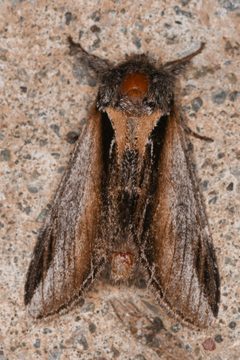
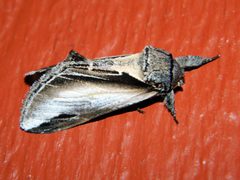
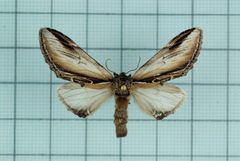
-level identification relies on forewing pattern details. Pheosia gnoma has a shorter white wedge-shaped streak at the tornus of the forewing compared to Pheosia tremula. of both species display prominent patterning with contrasting light and dark markings.
Images
Habitat
Woodland, heathland, moorland, plantations, riversides, parks and gardens. Specific associations vary by : Pheosia gnoma occupies birch-dominated , while Pheosia tremula occurs in poplar and willow stands.
Distribution
Palearctic distribution. Records from Denmark, Norway, Sweden, northern and central Europe, Russia, and the British Isles. Pheosia gnoma is widespread across southern Britain with localized northern ; Pheosia tremula is common in England and Wales, more local in Scotland. North American records exist from Vermont, USA.
Seasonality
periods: late April-June and August. Peak activity in May-June with a second in August.
Diet
Larval feeding is -specific: Pheosia gnoma larvae feed on silver and downy birch (Betula spp.); Pheosia tremula larvae feed on poplar (Populus sp.) and sallow (Salix sp.).
Life Cycle
Complete with larval feeding on woody plants, underground where pupae overwinter, and in two per year.
Behavior
are attracted to light in small numbers. Pheosia tremula has been used in electrophysiological studies due to its simple auditory system with a single auditory receptor associated with each tympanic on the second thoracic segment.
Human Relevance
Subject of genomic research through the Darwin Tree of Life Project. Pheosia gnoma : 271.3 Mb, 31 chromosomal pseudomolecules, 11,628 protein-coding genes. Pheosia tremula genome: 290 Mb, 31 chromosomal pseudomolecules. Used as a model for studying auditory reception in insects with simple ears.