
Lochmaeus manteo
Doubleday, 1841
Variable Oakleaf Caterpillar Moth
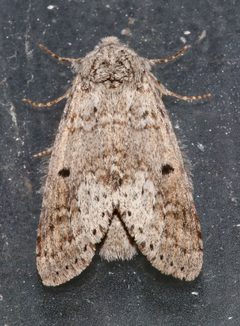
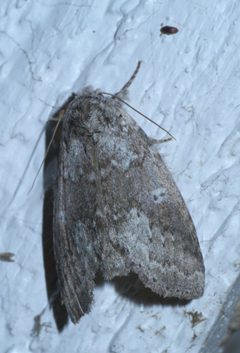
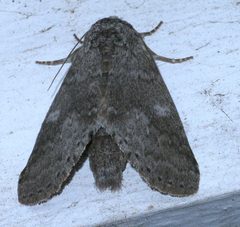
Lochmaeus manteo is a in the Notodontidae, commonly known as the variable oakleaf caterpillar moth. It occurs in eastern North America, where are active from April through October. The is a late-season defoliator of deciduous trees, with larvae feeding primarily on Quercus (oak) species. While larval feeding can cause noticeable damage and produce abundant , single defoliation events rarely cause significant long-term harm to tree health.
Pronunciation
How to pronounce Lochmaeus manteo: //ˈlɒk.meɪ.əs ˈmæn.te.oʊ//
These audio files are automatically generated. While they are not always 100% accurate, they are a good starting point.
Identification
have a wingspan of 37–50 mm. The can be distinguished from similar notodontid by its specific wing pattern and size range. Larvae are recognized as the "variable oakleaf caterpillar," though specific diagnostic features for separating this species from related Heterocampa species are not detailed in available sources.
Images
Habitat
Associated with deciduous forests and woodlands, particularly areas containing oak trees. Larvae feed on foliage of trees in the .
Distribution
Eastern North America. Records include the United States and Canada (Manitoba, Vermont).
Seasonality
are on wing from April to October. Larvae are present in late summer and early fall, contributing to the late-season defoliator guild.
Diet
Larvae feed on various deciduous trees, especially Quercus (oak) . Specific feeding habits are not documented.
Host Associations
- Quercus - larval Primary ; larvae feed on oak foliage
Life Cycle
Complete with , larval, pupal, and stages. Specific details on egg placement, sites, or stage are not documented in available sources.
Behavior
Larvae are solitary feeders rather than gregarious. During conditions, larval feeding produces abundant that can accumulate on surfaces beneath infested trees and create audible sounds in forests. are and attracted to light.
Ecological Role
As a primary consumer, larvae transfer energy from oak foliage to higher . The serves as prey for various natural enemies including such as Ammophila procera. Late-season defoliation typically has minimal impact on overall forest health due to timing of feeding relative to tree physiology.
Human Relevance
Occasional pest of ornamental oaks in urban and suburban settings. Defoliation and accumulation can generate public concern and aesthetic complaints, though management is rarely necessary for tree health. Mechanical removal of larvae or targeted applications may be warranted for high-value specimen trees.
Similar Taxa
- Heterocampa speciesRelated notodontid with similar larval and oak-feeding habits; specific separation criteria not provided in sources
- Other late-season defoliators (Anisota, Dryocampa, Datana)Share similar seasonal timing and hardwood associations; differ in larval (e.g., Anisota are gregarious, Lochmaeus are solitary)
More Details
Parasitoid associations
Documented as a for the thread-waisted wasp Ammophila procera, which provisions its nests with paralyzed caterpillars of this .
Outbreak dynamics
A 2017 in North Carolina was notable for the audible sound of falling in forests, illustrating the ' potential to reach high densities under favorable conditions.