
Cecrita cubana
(Grote, 1866)
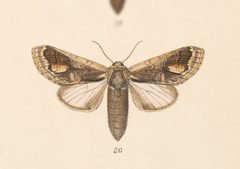
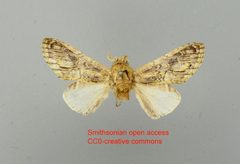
Cecrita cubana is a of prominent in the Notodontidae, described by Grote in 1866. It belongs to the Cecrita, a group of North American moths whose larvae are known as "prominents" due to their characteristic humps or projections. The species epithet "cubana" suggests a possible Caribbean association, though the species occurs in North America. are and attracted to light.
Pronunciation
How to pronounce Cecrita cubana: /sɛˈkritə kuˈbænə/
These audio files are automatically generated. While they are not always 100% accurate, they are a good starting point.
Identification
Distinguished from other Cecrita by genitalia examination; superficially similar to Cecrita guttivitta and Cecrita biundata but with subtle differences in forewing pattern and size. Forewing pattern of C. cubana tends toward more uniform gray-brown with less contrasting markings than C. guttivitta. Accurate identification often requires dissection and comparison of male genitalia, particularly the shape of the valve and .
Images
Habitat
Deciduous and mixed forests, woodlands, and areas with tree presence. Found in both mature forest and disturbed where food plants grow.
Distribution
Eastern North America, from southern Ontario and Quebec south to Florida, west to Texas and Oklahoma. The name "cubana" is misleading; the does not occur in Cuba but is named possibly for a type locality or collector association.
Seasonality
active from late May through August, with peak activity in June and July in most of range. Single brooded in northern portion of range; possibly partial second in southern areas.
Host Associations
- Fagus grandifolia - larval American beech; primary based on -level records for Cecrita
- Betula - larval Birch ; inferred from congeneric records, requires confirmation for C. cubana specifically
Life Cycle
laid on foliage. Larva feeds on leaves, developing through five instars. Mature larva descends to ground and pupates in soil or leaf litter. emerges following spring or after . Specific timing and details of C. cubana not well documented; pattern inferred from congeneric .
Behavior
, attracted to light. Larvae solitary feeders, resting along leaf midribs or twigs with body appressed to substrate, a characteristic posture of prominent larvae. When disturbed, larvae may raise or body segments in a defensive posture.
Ecological Role
Larva acts as leaf-chewing herbivore on deciduous trees, contributing to nutrient cycling through herbivory and deposition. Serves as prey for birds, , and other . Not a significant forest pest.
Human Relevance
No economic importance. Occasionally encountered by naturalists and enthusiasts at light traps. Larvae may be found during surveys or beat-sampling of trees.
Similar Taxa
- Cecrita guttivittaOverlapping range and similar size; C. guttivitta has more contrasting forewing pattern with distinct white spots and darker transverse lines, and feeds primarily on cherry (Prunus).
- Cecrita biundataSimilar gray-brown coloration; C. biundata has two prominent undulating dark lines across forewing and different male genitalia structure.
- Datana integerrimaSimilar size and coloration but in Notodontidae Phalerinae; Datana have more uniform forewings without distinct pattern elements and different resting posture.
Misconceptions
The specific epithet "cubana" does not indicate Cuban distribution; the is to eastern North America. The origin of the name remains unclear, possibly referring to a collector, type locality, or historical misidentification.
More Details
Taxonomic history
Originally described as Litoprosopus cubana by Grote in 1866, later transferred to Cecrita. The Cecrita was revised in the mid-20th century, with C. cubana maintained as a valid distinct from C. guttivitta and C. biundata based on genitalic differences.
Conservation status
Not evaluated by IUCN; appears secure throughout range based on iNaturalist observations and collection records, though localized declines possible due to loss and beech bark affecting primary .