
Dioptinae
Walker, 1862
Genus Guides
1- Phryganidia(California Oak Moth)
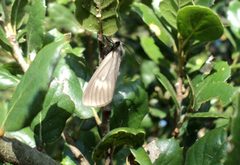
Dioptinae is a of in the Notodontidae, comprising approximately 60 distributed primarily across the Neotropical region. Members are notable for being almost exclusively day-flying moths, a trait uncommon among Lepidoptera. The subfamily was formerly treated as a separate family (Dioptidae) before reclassification into Notodontidae. Many exhibit aposematic coloration, and the group includes economically significant species such as the California Oak Moth.
Pronunciation
How to pronounce Dioptinae: /daɪˈɑptɪniː/
These audio files are automatically generated. While they are not always 100% accurate, they are a good starting point.
Identification
Dioptinae can be distinguished from other Notodontidae by their activity pattern and often bright, warning coloration. typically possess reduced or non-functional . The is divided into two tribes: Josiini (with such as Josia, Lyces, and Scea) and Dioptini (including Dioptis, Erbessa, and Polypoetes). Male are often pectinate. Larvae frequently display distinctive defensive and coloration.
Images
Habitat
Primarily Neotropical forests and woodlands, ranging from lowland tropical to montane elevations. The California Oak Moth (Phryganidia californica) occurs in coastal oak woodlands and mixed evergreen forests of California and southwestern Oregon.
Distribution
Almost exclusively Neotropical, with greatest diversity in Central and South America. The Caribbean region harbors . One notable exception is Phryganidia californica, which extends into the Nearctic region along the Pacific coast of North America from Oregon to Baja California.
Seasonality
Variable by and region. Phryganidia californica exhibits two annually in northern California and three generations in southern California. Most tropical species likely breed continuously or with seasonality tied to wet/dry cycles.
Diet
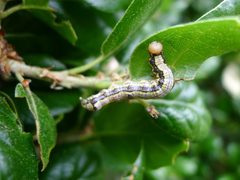
Larvae are herbivorous, feeding on diverse plants including oaks (Quercus), chinquapin (Castanopsis), Lithocarpus, eucalyptus, chestnut, and azalea. Quararibea cordata (Malvaceae) has been confirmed as a host plant for the . of many have reduced mouthparts and do not feed.
Host Associations
- Quercus agrifolia - Preferred of Phryganidia californica
- Castanopsis chrysophylla - in southwestern Oregon
- Lithocarpus densiflorus - Incidental
- Quararibea cordata - Confirmed plant for (Malvaceae), commonly known as 'zapote'
Life Cycle
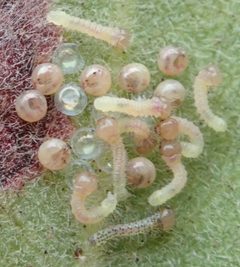
Holometabolous with complete . Phryganidia californica: laid in loose clusters on foliage, limbs, or trunks; caterpillars undergo five instars, reaching approximately 25 mm; occurs in exposed, non-cocooned pupae suspended by silk threads; pupae boldly marked in black and white or yellow, resembling chrysalises.
Behavior
are , flying during daylight hours rather than at night. is generally weak but sufficient for . Males use pectinate to detect female . Larvae of some exhibit gregarious during . Phryganidia californica rarely flies to lights at night.
Ecological Role
Larvae function as herbivores and periodic defoliators of woody plants. During , Phryganidia californica can completely defoliate oak trees, though trees rarely die. Caterpillars and pupae serve as for including tachinid flies (Actia flavipes, Hyphantrophaga virillis, Ceranthia sp.) and ichneumon wasps (Mesochorus). and bassiana fungus regulate populations.
Human Relevance
Phryganidia californica is an economically significant forest pest in California, causing aesthetic damage to ornamental oaks and periodic concern for forest health. Despite dramatic defoliation events, permanent tree damage is rare. The has historical taxonomic importance due to its former -level status and complex classification history.
Similar Taxa
- NotodontinaeOther of Notodontidae; Dioptinae distinguished by activity and often aposematic coloration
- Josiidae (historical)Formerly treated as separate ; now synonymized as tribe Josiini within Dioptinae
More Details
Taxonomic History
The has undergone extensive reclassification. Formerly placed in its own Dioptidae, it was reclassified into Notodontidae. The tribe Josiini was treated as family Josiidae by Piepers & Snellen (1900) and as subfamily Josiinae by Kiriakoff (1950).
Defensive Chemistry
Many dioptine larvae sequester defensive compounds from plants, contributing to aposematic coloration and unpalatability to .
Population Dynamics
Phryganidia californica exhibits periodic with intervals of several years between major events, likely regulated by natural enemies, weather, and plant quality.
Sources and further reading
- BugGuide
- Wikipedia
- iNaturalist taxon
- NCBI Taxonomy
- Catalogue of Life
- Bug Eric: Moth Monday: California Oak Moth
- Dioptine Moths of the Caribbean Region: Description of Two New Genera with Notes on Biology and Biogeography (Lepidoptera: Notodontidae: Dioptinae)
- A new species of Polypoetes Druce, 1885 (Lepidoptera: Notodontidae) from Colombia, with confirmation of a new host plant for the Dioptinae