
Phryganidia
Packard, 1864
California Oak Moth
Species Guides
1- Phryganidia californica(California Oak Moth)
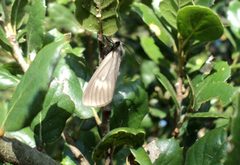
Phryganidia is a of prominent moths in the Notodontidae, containing three found in western North America. The genus is best known for Phryganidia californica, commonly called the California Oak Moth or California Oakworm, which undergoes periodic that can cause extensive defoliation of oak trees along the California coast. The genus was formerly placed in its own family, Dioptidae, but has been reclassified into Notodontidae. are dull brown with weak , while larvae are specialized feeders on oak foliage.
Pronunciation
How to pronounce Phryganidia: /ˌfrɪɡəˈnɪdiə/
These audio files are automatically generated. While they are not always 100% accurate, they are a good starting point.
Identification
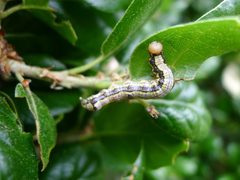
are distinguished from similar brown notodontid by their weak , activity pattern, and association with oak . Males can be identified by their pectinate . Larvae are recognized by their skeletonizing feeding pattern on oak leaves and the characteristic damage they produce. The boldly patterned, cocoon-less pupa suspended by silk threads is distinctive. The was historically placed in Dioptidae due to larval characteristics but is now classified in Notodontidae based on adult .
Images
Habitat
Associated with oak woodlands and forests. In California, primarily found in coastal regions where California Live Oak (Quercus agrifolia) occurs, with extending inland to central valleys during years. In southwest Oregon, occurs in supporting Giant Chinkapin (Castanopsis chrysophylla), Canyon Live Oak, and Tan Oak.
Distribution
Western North America, from southwest Oregon through California to the Mexican border. The occurs primarily in the western half of California, with Phryganidia californica reaching its northern limit in Oregon and Phryganidia chihuahua occurring in Chihuahua, Mexico.
Seasonality
Phryganidia californica has two per year in northern California and three generations per year in southern California. are active during daylight hours rather than at night. laid on leaf undersides late in the season can overwinter.
Diet
Larvae feed primarily on oaks (Quercus spp.), with Quercus agrifolia (California Live Oak) as the preferred . Incidental hosts include eucalyptus, chestnut, Tan Oak (Lithocarpus densiflorus), and azalea. In Oregon, larvae feed on Giant Chinkapin (Castanopsis chrysophylla) and Canyon Live Oak.
Host Associations
- Quercus agrifolia - primary California Live Oak, preferred
- Quercus spp. - primary oaks generally
- Eucalyptus - incidental
- Castanea - incidental chestnut
- Lithocarpus densiflorus - incidental Tan Oak
- Rhododendron - incidental azalea
- Castanopsis chrysophylla - primary Giant Chinkapin, in Oregon
- Quercus chrysolepis - primary Canyon Live Oak
Life Cycle
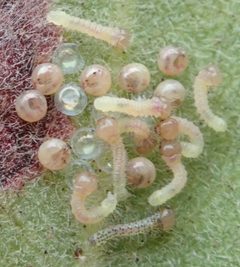
Females lay in loose clusters on foliage, limbs, or trunks of trees. Eggs on leaf undersides late in the season can overwinter. Larvae hatch and undergo five instars, skeletonizing leaves initially then consuming entire leaf tissue except major . Mature larvae pupate without forming a cocoon, suspended by silk threads. Pupae are exposed and visually conspicuous. The completes in 2–3 annually depending on latitude.
Behavior
fly weakly but effectively enough to disperse. They are diurnally active and rarely attracted to lights at night. Males use pectinate to locate females by . During , occurs inland from coastal areas. Larvae skeletonize leaves and can completely defoliate trees in years.
Ecological Role
Larvae function as significant herbivores on oak trees, capable of causing extensive but generally non-lethal defoliation. The serves as for multiple species including tachinid flies (Actia flavipes, Hyphantrophaga virillis, Ceranthia sp.) and an ichneumon (Mesochorus sp.). occurs through and the fungus bassiana, which cause significant larval mortality during .
Human Relevance
Considered a forest pest due to periodic that cause visually dramatic defoliation of oak trees along the California coast. Despite the severity of defoliation, trees rarely die. The is of interest to entomologists studying , , and - relationships. Formerly classified in its own , its reclassification illustrates ongoing revisions in lepidopteran .
Similar Taxa
- Other Notodontidae Phryganidia are dull brown like many notodontids but differ in their activity, weak , and lack of attraction to lights. Formerly separated in Dioptidae based on larval characteristics.
- Butterfly pupaeThe exposed, cocoon-less, boldly marked pupa of Phryganidia is superficially similar to a chrysalis and may be mistaken for one.
Misconceptions
The "California Oak Moth" is misleading because the caterpillars () cause the visible damage, not the . The name "California Oakworm" is considered more appropriate. Despite dramatic defoliation during , the is rarely responsible for tree death; oak trees generally recover.
More Details
Taxonomic history
Formerly placed in its own Dioptidae, Phryganidia has been reclassified into Notodontidae, Dioptinae, based on morphological characteristics.
Population dynamics
The undergoes periodic of irregular timing. During , complete defoliation of coastal oak forests can occur, with larvae dispersing inland to central valleys.
Natural enemies
Documented include tachinid flies Actia flavipes, Hyphantrophaga virillis, and a Ceranthia , plus ichneumon Mesochorus. and bassiana fungus are significant mortality agents; virus-killed larvae hang as limp brown corpses, while fungal produces white powdery coating with unpleasant odor.