
Syngrapha alias
(Ottolengui, 1902)
hooked silver Y, Hooked Silver Y Moth
Syngrapha alias is a noctuid native to North America, first described by Rodrigues Ottolengui in 1902. The exhibits a transcontinental distribution spanning and montane regions from Newfoundland to Alaska, with southern extensions to California and North Carolina. are active during summer months, with larvae specializing on white spruce and black spruce.
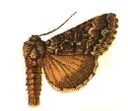
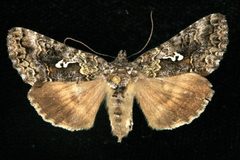
Pronunciation
How to pronounce Syngrapha alias: //sɪnˈɡræfə ˈeɪliəs//
These audio files are automatically generated. While they are not always 100% accurate, they are a good starting point.
Identification
Distinguished from congeneric Syngrapha by the distinctive hooked configuration of the forewing marking. The 'silver Y' pattern is diagnostic within the , though precise differentiation from similar Plusiinae may require examination of genitalia. Short-winged forms occur in some and should not be confused with different species.
Images
Appearance
Medium-sized noctuid with wingspan of 30–34 mm. Forewings display characteristic hooked or curved marking resembling a silver Y shape, from which the derives. Coloration typically muted gray-brown with distinct pattern elements. Body relatively compact, consistent with Plusiinae .
Habitat
forest and montane coniferous woodland, particularly associated with spruce-dominated . Occurs from near treeline in northern latitudes to mixed conifer-hardwood forests in southern range extensions. Found in both pristine and moderately disturbed forest .
Distribution
North America: Newfoundland west to Alaska and Vancouver Island; north to near Arctic treeline; south to coastal northern California and Arizona in the west, North Carolina in the east. Canadian provinces: Alberta, Manitoba, Saskatchewan. US state: Vermont.
Seasonality
period June to August, with exact timing varying by latitude and elevation. Single per year () in most of range.
Diet
Larval stage feeds specifically on Picea glauca (white spruce) and Picea mariana (black spruce). feeding habits not documented.
Host Associations
- Picea glauca - larval food plantwhite spruce
- Picea mariana - larval food plantblack spruce
Life Cycle
Complete with four stages: , larva, pupa, . Larval development occurs on spruce . presumably in soil or leaf litter. stage not explicitly documented but likely as pupa or late-instar larva given .
Ecological Role
Larval herbivore in coniferous forest . Specialized association with Picea suggests potential role in nutrient cycling and as prey item for . Specific ecological functions beyond herbivory not documented.
Human Relevance
Minor economic significance; occasional defoliator of spruce in forest settings but not considered major pest. Presence indicates intact spruce forest .
Similar Taxa
- Syngrapha epigaeaSimilar forewing pattern; requires genitalic examination for reliable separation
- Syngrapha octoscriptaOverlapping range and convergent Plusiinae wing patterns
- Autographa speciesFormerly classified in same ; share silver Y marking but with different hook configuration
More Details
Subspecies
Two recognized : Syngrapha alias alias (nominate form) and Syngrapha alias interalia. Geographic differentiation between subspecies not fully characterized in available sources.
Taxonomic History
Originally described as Autographa alias by Ottolengui in 1902; subsequently transferred to Syngrapha based on morphological and phylogenetic revisions of Plusiinae.