
Plusia nichollae
(Hampson, 1913)
West Coast Plusia
Plusia nichollae is a of looper in the Noctuidae, Plusiinae. It is native to North America, with a distribution concentrated on the western coast of the continent as suggested by its . The species was described by Hampson in 1913, originally placed in the Phytometra. Like other members of the genus Plusia, it is characterized by looping locomotion in its larval stage due to reduced number. The MONA or Hodges number for this species is 8951.
Pronunciation
How to pronounce Plusia nichollae: /ˈpluːziə nɪˈkɒleɪ/
These audio files are automatically generated. While they are not always 100% accurate, they are a good starting point.
Identification
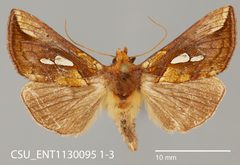
of Plusia nichollae can be distinguished from other North American Plusia by geographic range and subtle wing pattern differences, though specific diagnostic characters require examination of genitalia or detailed wing markings. Larvae possess the typical plusiine looper : three pairs of (on abdominal segments 3–6), resulting in the characteristic looping gait. This separates them from geometrid loopers, which have only two pairs of prolegs (segments 5–6). The species is most reliably distinguished from the closely related Plusia putnami (Putnam's looper) and other sympatric Plusia species by distribution and subtle differences in forewing pattern, particularly the configuration of the silvery or golden stigma markings typical of the .
Images
Distribution
North America, with records concentrated in western coastal regions of the United States and Canada. The specific epithet and suggest association with the Pacific coastal zone.
Behavior
Larvae exhibit the characteristic looping locomotion of Plusiinae, arching the body to bring the forward to the thoracic legs, then extending the body. This movement pattern is an to the reduced number of prolegs.
Similar Taxa
- Plusia putnamiPutnam's looper overlaps in western North American distribution and shares similar wing pattern with silvery stigma; separation requires examination of genitalia or detailed wing venation
- Chrysodeixis includensSoybean looper is superficially similar in larval form and wing pattern, but is distinguished by different geographic distribution (eastern and central North America, South America) and subtle differences in forewing markings
- Trichoplusia niCabbage looper is a widespread agricultural pest with similar looping larval and wing pattern; distinguished by more distribution and association with cultivated Brassicaceae
More Details
Nomenclature
The was originally described as Phytometra nichollae by Hampson in 1913 and later transferred to Plusia. The specific epithet likely honors an individual, possibly a collector or entomologist associated with early western North American lepidopteran surveys.
Research status
This has received limited focused study compared to economically important plusiines such as Trichoplusia ni or Chrysodeixis includens. Most records derive from general faunal surveys and museum collections rather than targeted ecological research.