
Plusia putnami
Grote, 1873
Putnam's Looper Moth, Lempke's Gold Spot
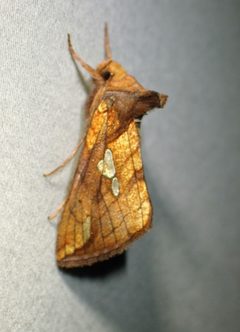
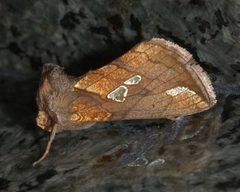
Plusia putnami is a noctuid with a trans-Holarctic distribution, occurring across northern Eurasia from Japan to western Europe and throughout much of North America. are active from July to August in western Europe and May to October in northern North America. The is notable for requiring genitalic dissection to reliably distinguish it from the similar Plusia festucae, as wing pattern differences between the two are not constant. The wingspan ranges from 32–42 mm.
Pronunciation
How to pronounce Plusia putnami: //ˈpluː.si.ə ˈpʌt.nə.maɪ//
These audio files are automatically generated. While they are not always 100% accurate, they are a good starting point.
Identification
Cannot be reliably distinguished from Plusia festucae based on wing pattern alone. Genitalic dissection is necessary for definitive identification. The two overlap broadly in distribution and , increasing the risk of misidentification based on external characters.
Images
Habitat
Found in a variety of open and semi-open across its extensive range, including grasslands, meadows, and forest edges. Specific microhabitat preferences are not well documented.
Distribution
Holarctic distribution. Palearctic: Japan, eastern Siberia, Fennoscandia, Great Britain, France, and Morocco ( barbara). Nearctic: Newfoundland and Labrador to central Alaska and interior British Columbia, south to Pennsylvania, Washington, north-eastern California, and in the Rocky Mountains to Utah and Colorado.
Seasonality
active July to August in western Europe; May to October in northern North America. Larval not well documented.
Diet
Larvae feed on Calamagrostis (reedgrass). feeding habits not documented.
Host Associations
- Calamagrostis - larval food plant
Life Cycle
Complete with , larva, pupa, and stages. Specific details of duration, stage, and number of per year are not documented in available sources.
Behavior
are and attracted to light. Larvae are loopers, moving with characteristic looping gait due to reduced number of .
Ecological Role
Larval herbivore on grasses; specific ecological impacts or interactions not documented.
Human Relevance
No significant documented economic or agricultural impact. Occasionally encountered by enthusiasts and in biodiversity surveys.
Similar Taxa
- Plusia festucaeOverlapping distribution and highly similar wing patterns that are not consistently different; requires genitalic dissection for reliable separation.
More Details
Taxonomic Subspecies
Four recognized: P. p. putnami (eastern and western North America), P. p. barbara (Morocco), P. p. festata (Far East, Altai Mountains, Japan), and P. p. gracilis (Europe, western Siberia).