
Autographa precationis
(Guenée, 1852)
Common Looper Moth
Autographa precationis, the Common Looper , is a Noctuid moth native to eastern and central North America. are medium-sized with a wingspan of 30–38 mm and are active from April through October, producing three or more annually. The has expanded its range to include cultivated soybeans, though with lower feeding than the closely related soybean looper. Larvae are bright green with distinctive black false eyespots on the and possess 21–23 per .
Pronunciation
How to pronounce Autographa precationis: //ɔːˈtɒɡrəfə priːkəˈtoʊnɪs//
These audio files are automatically generated. While they are not always 100% accurate, they are a good starting point.
Identification
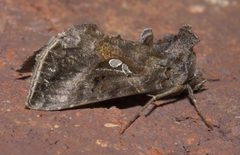
Distinguished from the soybean looper (Chrysodeixis includens, formerly Pseudoplusia includens) by conjoined silver forewing spots (separated in C. includens) and duller wing surface. Larvae separable by count: A. precationis has 21–23 crochets per versus fewer in related loopers. Black false eyespots on larval also aid identification.
Images
Habitat
Found in open supporting herbaceous vegetation, including agricultural fields, meadows, and disturbed areas. Has adapted to soybean within its range.
Distribution
Eastern and central North America, including Canadian provinces (Manitoba, Saskatchewan, Quebec, Ontario) and United States from New England southward. Also recorded from Oceania (likely introduced).
Seasonality
active April through October depending on latitude. Three or more per year in most of range.
Diet
Larvae feed on various forbs across multiple : Apiaceae, Asteraceae, Brassicaceae, Chenopodiaceae, Convolvulaceae, Fabaceae (including soybean), Malvaceae, Plantaginaceae, and Verbenaceae.
Host Associations
- Glycine max - larval food plantSoybean; added to range recently, with lower feeding than native hosts
- Apiaceae - larval food plant
- Asteraceae - larval food plant
- Brassicaceae - larval food plant
- Chenopodiaceae - larval food plant
- Convolvulaceae - larval food plant
- Fabaceae - larval food plant
- Malvaceae - larval food plant
- Plantaginaceae - larval food plant
- Verbenaceae - larval food plant
Life Cycle
Multivoltine with three or more annually. stage not explicitly documented in sources. Larval development occurs on herbaceous plants; nectar at flowers.
Behavior
are or . Larvae exhibit looping locomotion due to reduced number, arching body to bring prolegs forward to thoracic legs.
Ecological Role
Herbivore; contributes to nutrient cycling in herbaceous . Larval feeding on soybeans creates agricultural pest status, though less damaging than Chrysodeixis includens due to lower feeding .
Human Relevance
Minor agricultural pest on soybeans and various crops. Often confused with more damaging soybean looper, requiring accurate identification for management decisions.
Similar Taxa
- Chrysodeixis includensFormerly Pseudoplusia includens; extremely similar appearance but with separated silver forewing spots, shinier wings, and higher soybean feeding
- Trichoplusia niCabbage looper; similar larval and looping , but different wing patterns
More Details
Host Range Expansion
The has been observed exploiting increased soybean planting in its native range, though laboratory studies show lower digestibility and food utilization on soybean compared to Chrysodeixis includens, suggesting preference differences.
Systematic Note
Member of Plusiinae, tribe Plusiini; Autographa contains multiple North American looper with similar .
Sources and further reading
- BugGuide
- Wikipedia
- GBIF taxonomy match
- iNaturalist taxon
- NCBI Taxonomy
- Catalogue of Life
- Do Moths Usually Land with Their Wings Down? | Bug Squad
- In the Loop--on the Mustard | Bug Squad
- Bug Squad
- Insect Migration (Part 1) - Buglife Blog - Buglife
- Mudo Pryfed (Rhan 1) - Buglife Blog - Buglife
- ID Challenge #14 | Beetles In The Bush