
Autographa mappa
(Grote & Robinson, 1868)
Wavy Chestnut Y Moth, Wavy Chestnut Y
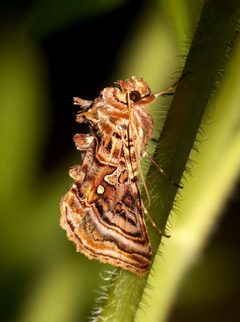
Autographa mappa, commonly known as the Wavy Chestnut Y , is a North American noctuid moth first described by Grote and Robinson in 1868. have a wingspan of 35–40 mm and are active from June to August, with one per year. The inhabits wooded regions across Canada and the northern United States.
Pronunciation
How to pronounce Autographa mappa: //ɔːˈtɒɡrəfə ˈmæpə//
These audio files are automatically generated. While they are not always 100% accurate, they are a good starting point.
Identification
The wavy chestnut-brown forewing pattern and Y-shaped marking distinguish this from similar Autographa. The specific epithet 'mappa' refers to the map-like patterning. It can be separated from the more widespread Silver Y (Autographa gamma) by distribution—A. gamma is primarily Palearctic—though both share the characteristic Y-mark. Within its North American range, it may be confused with other Plusiinae such as Autographa californica, but the wavy chestnut patterning and specific geographic distribution aid identification.
Images
Appearance
have a wingspan of 35–40 mm. The forewings display a characteristic wavy pattern with chestnut brown tones. The hindwings are typically paler. The refers to the distinctive Y-shaped marking on the forewings, a trait shared with other Autographa .
Habitat
Wooded portions of Canada and the northern United States, including deciduous and mixed forests. The is associated with forested where larval plants occur.
Distribution
North America: Newfoundland west across wooded Canada to Vancouver Island; south in the east to Maine, New Hampshire, and Wisconsin; in western mountains south to Colorado and Oregon. Records from Alberta, Manitoba, and Saskatchewan.
Seasonality
are on wing from June to August, with timing varying by location. One per year ().
Diet
Larvae feed on Urtica (nettles) and Vaccinium (blueberries, cranberries, and relatives) . feeding habits are not documented in available sources.
Host Associations
- Urtica - larval food plant of nettles
- Vaccinium - larval food plantincludes blueberries, cranberries, bilberries
Life Cycle
One per year. active June–August. Larval stage feeds on plants; presumably occurs in soil or leaf litter, though specific details are not documented.
Ecological Role
Larvae function as herbivores on forest understory plants. The contributes to nutrient cycling in woodland and serves as prey for .
Human Relevance
No significant documented economic impact. Not known as a major agricultural pest. The is of interest to lepidopterists and naturalists documenting North American diversity.
Similar Taxa
- Autographa gammaShares the characteristic Y-shaped forewing marking, but A. gamma is primarily Palearctic in distribution and a noted long-distance migrant, whereas A. mappa is restricted to North America.
- Autographa californicaAnother North American Autographa with similar looper caterpillar , but with different coloration (more mottled brown/black/gray) and broader western distribution including California.
More Details
Taxonomic history
Originally described as Plusia mappa by Grote & Robinson in 1868, later transferred to Autographa.
Etymology
The specific epithet 'mappa' refers to the map-like pattern on the forewings; 'Wavy Chestnut Y' describes both the coloration and the diagnostic Y-mark.
Sources and further reading
- BugGuide
- Wikipedia
- GBIF taxonomy match
- iNaturalist taxon
- NCBI Taxonomy
- Catalogue of Life
- Do Moths Usually Land with Their Wings Down? | Bug Squad
- In the Loop--on the Mustard | Bug Squad
- Bug Squad
- Insect Migration (Part 1) - Buglife Blog - Buglife
- Mudo Pryfed (Rhan 1) - Buglife Blog - Buglife
- ID Challenge #14 | Beetles In The Bush