
Polychrysia esmeralda
(Oberthür, 1880)
delphinium leaftier
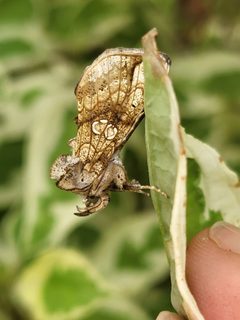
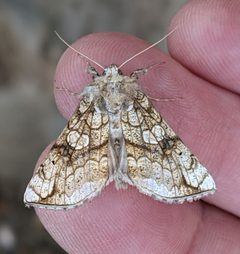
Polychrysia esmeralda, commonly known as the delphinium leaftier, is a noctuid described by Charles Oberthür in 1880. The name derives from Greek roots meaning "many" and "gold," referring to the 's shining golden wing coloration. It occurs across northern North America and eastern Siberia, with larvae specializing on toxic Ranunculaceae plants including monkshood and delphinium. The species is notable for its distinctive larval of tying leaves together with silk and spinning a gold-colored cocoon within.

Pronunciation
How to pronounce Polychrysia esmeralda: //ˌpɒlɪˈkrɪsiə ˌɛzməˈrældə//
These audio files are automatically generated. While they are not always 100% accurate, they are a good starting point.
Identification
resemble Polychrysia moneta but can be distinguished by two key characters: the upperside of the wings is darker (more golden) in P. esmeralda versus paler in P. moneta, and the curved extrabasal line below the of the forewings is simple (single) in P. esmeralda but double in P. moneta. The golden cocoon and leaf-tying of larvae are also distinctive.
Images
Distribution
Northern North America (Alaska, British Columbia, Alberta, Saskatchewan, Manitoba) and eastern Siberia, Asia.
Diet
Larvae feed on monkshood (Aconitum ) and larkspur/delphinium (Delphinium species). have been reported to feed on nectar of fireweed (Chamerion species).
Host Associations
- Aconitum - larval food plantmonkshood
- Delphinium - larval food plantlarkspur/delphinium
- Chamerion - nectar sourcefireweed
Life Cycle
are yellow. Larvae are bright green and move in a looper fashion. Fully grown larvae tie leaves together with silk and spin a gold-colored cocoon within this shelter to pupate.
Behavior
Larvae move in a characteristic looper fashion. Mature larvae construct leaf shelters by tying leaves together with silk threads, within which they spin their gold-colored cocoon.
Ecological Role
Larval herbivore on toxic Ranunculaceae plants containing alkaloids; potential as .
Human Relevance
Minor potential pest of ornamental delphinium and monkshood plants in gardens. The has been used as a model for studying insect-plant chemical due to its specialization on alkaloid-rich plants.
Similar Taxa
- Polychrysia moneta appear similar but P. moneta has paler wing upperside and double (not simple) curved extrabasal line below the of the forewings.
More Details
Etymology
The name Polychrysia derives from Ancient Greek πολύς (polus) = "many" and χρυσός (khrusos) = "gold", referring to the golden appearance of the .
Taxonomic history
Originally described as Plusia moneta var. esmeralda by Oberthür in 1880, later elevated to status in the Polychrysia.
Sources and further reading
- BugGuide
- Wikipedia
- GBIF taxonomy match
- iNaturalist taxon
- NCBI Taxonomy
- Catalogue of Life
- Colony of Red Ants Roams the Bohart Museum of Entomology | Bug Squad
- UC Davis Zika Symposium: A Crucial Message | Bug Squad
- Interest Spiking in the May 26th UC Davis Zika Public Awareness Symposiun | Bug Squad
- Redefining nature-based decision-making: Pensoft joins EU project SELINA
- nature-based | Blog
- SELINA | Blog