
Diachrysia
Hübner, 1821
burnished brass moths
Species Guides
2- Diachrysia aereoides(Dark-spotted Looper)
- Diachrysia balluca(green-patched looper)
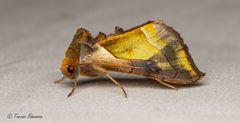
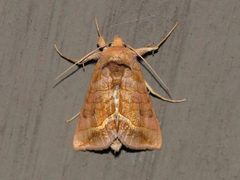
Diachrysia is a of noctuid comprising approximately eleven , distributed across the Holarctic region. The genus is best known for the burnished brass (D. chrysitis), which displays striking structural coloration on its forewings. Species in this genus are characterized by metallic golden or brassy wing patches produced by nanoscale multilayer structures rather than chemical pigments. The taxonomic relationship between D. chrysitis and the closely related D. stenochrysis remains unresolved in some .

Pronunciation
How to pronounce Diachrysia: /daɪəˈkrɪsiə/
These audio files are automatically generated. While they are not always 100% accurate, they are a good starting point.
Identification
recognized by forewings with metallic golden or brassy patches; D. chrysitis shows two distinct wing pattern morphs—typical form with two separate gold bands, and 'juncta' form with H-shaped bridge connecting golden regions. Structural coloration (iridescent sheen) distinguishes this from superficially similar noctuids with pigment-based yellow markings. -level identification requires examination of genitalia or due to overlapping morphological traits.
Images
Habitat
Woodland ; frequently encountered at light traps.
Distribution
Holarctic distribution: widespread across Europe including UK, Scandinavia (Denmark, Norway, Sweden), Russia; extends into North America (Vermont, USA); Eastern Palearctic represented by D. stenochrysis and other Asian .
Seasonality
active June through September in UK , with two overlapping ; second generation has increased in frequency since 1970.
Diet
Larvae feed primarily on nettle (Urtica dioica); occasionally other herbaceous plants.
Host Associations
- Urtica dioica - larval plantprimary food source for D. chrysitis larvae
Life Cycle
in UK (two per year); period June-September with overlapping generations.
Behavior
attracted to light traps. Structural coloration in forewings generated by nanoscale multilayer structure with irregular spheres, producing iridescent gold sheen without chemical pigments.
Human Relevance
D. chrysitis (burnished brass) serves as a model organism for studying structural coloration in Lepidoptera; sequenced (386.4 Mb assembly, 18,320 protein-coding genes).
Similar Taxa
- Diachrysia stenochrysisTaxonomically unresolved relationship with D. chrysitis; historically treated as separate or ; CO1 barcoding has not fully clarified species boundaries in UK .
More Details
Genome sequencing
Diachrysia chrysitis assembled at 386.4 Mb with 31 chromosomal pseudomolecules (30 + Z ) and 18,320 protein-coding genes; specimen from Wytham Woods, UK had 'juncta' wing pattern morph.