
Diachrysia balluca
Geyer, 1832
green-patched looper, hologram moth
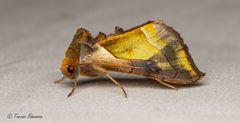
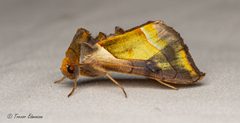
Diachrysia balluca is a large noctuid occurring in northeastern North America, recognized by its metallic green forewing patches. are active from May through September, with peak abundance in July. The inhabits mature poplar and mixedwood forests, where larvae feed on woody plants including quaking aspen and Canadian woodnettle. It produces one annually.
Pronunciation
How to pronounce Diachrysia balluca: /di.aˈkrɪ.si.a bəˈluː.kə/
These audio files are automatically generated. While they are not always 100% accurate, they are a good starting point.
Identification
Distinguished from other Diachrysia by the combination of large size (largest North American plusiine), pointed forewings with extensive metallic green patches on the outer two-thirds, and grey unmarked hindwings. Similar species D. stenochrysis and D. chrysitis are nearly indistinguishable externally and require genetic analysis for reliable separation; these species show only 0.93% minimum pairwise genetic divergence.
Images
Habitat
Mature poplar and mixedwood forests in northeastern North America. Associated with forested environments containing plants.
Distribution
Northeastern North America from Nova Scotia west to Manitoba, south to western North Carolina. Southern distributional limit is Great Smoky Mountains National Park. Disjunct records exist from Georgia (type locality, 1832) and northwestern Florida (1965), possibly representing strays.
Seasonality
active May through September, with peak observations in July. One per year.
Diet
Larvae feed on woody plants: common hop (Humulus lupulus), quaking aspen (Populus tremuloides), Canadian woodnettle (Laportea canadensis), and Rubus . visit flowers of Asteraceae.
Host Associations
- Humulus lupulus - larval food plantcommon hop
- Populus tremuloides - larval food plantquaking aspen
- Laportea canadensis - larval food plantCanadian woodnettle; confirmed for
- Rubus - larval food plant level
- Asteraceae - nectar sourceflower visitation
Life Cycle
Holometabolous development with four stages: , larva, pupa, . Laboratory-reared Plusiinae specimens developed from egg to adult in approximately 30 days: five instars (3-5 days each), prepupal stage (1-2 days), pupal stage (8 days). One per year.
Behavior
; flies at night. mate on second day following ; multiple matings occur regularly. Females produce to attract males. Males emit volatile chemical from abdominal hair pencils, possibly serving as mating recognition signal. Females deposit 200-300 during lifetime.
Human Relevance
No documented economic impact specific to this . Plusiinae larvae generally are known to damage crops, vegetables, greenhouse plants and ornamental herbs, but D. balluca is primarily associated with native forest rather than agricultural settings.
Similar Taxa
- Diachrysia stenochrysisNearly identical external appearance; requires genetic analysis for separation; 0.93% minimum pairwise genetic divergence
- Diachrysia chrysitisNearly identical external appearance; requires genetic analysis for separation; 0.93% minimum pairwise genetic divergence
More Details
Iridescence function
Metallic green forewing patches may serve multiple functions: evasion through optical illusion effects, recognition, and courtship signaling. Iridescence in has been linked to predator avoidance despite appearing conspicuous.
Genetic resources
Barcode Index Number (BIN) assigned on BOLD (TaxID: 21796). Nine genetic sequences available on NCBI (txid689076) as of September 2023.
Larval detection difficulty
Larvae are small and inconspicuous compared to , contributing to sparse observational records of stages despite striking adult appearance.