
Panthea greyi
Anweiler, 2009
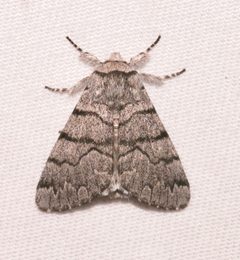
Panthea greyi is a noctuid described in 2009 by Anweiler. It is known from montane regions of the southwestern United States, specifically in Arizona, New Mexico, Colorado, and southern Utah, at elevations between 1524 and 2545 meters. are active during summer months, with males having a wingspan of 38–45 mm and females 42–50 mm.
Pronunciation
How to pronounce Panthea greyi: /ˈpænθiə ˈɡreɪi/
These audio files are automatically generated. While they are not always 100% accurate, they are a good starting point.
Identification
Panthea greyi can be distinguished from congeneric by its restricted montane distribution in the southwestern United States and by size differences between sexes. Accurate identification requires examination of genitalia and comparison with related Panthea species.
Images
Appearance
exhibit in size. Males have a wingspan of 38–45 mm; females are larger at 42–50 mm. Specific coloration and pattern details are not documented in available sources.
Habitat
Montane coniferous forests at elevations of 1524–2545 meters.
Distribution
Mountains of Arizona, New Mexico, Colorado, and southern Utah, United States.
Seasonality
are on wing from June to September.
Life Cycle
stage unknown. present June through September.
Similar Taxa
- Panthea portlandiaOverlapping geographic range in western North America; requires genitalia examination for definitive separation
- Panthea furcillaSimilar montane preferences in western North America; morphological comparison needed for identification
More Details
Taxonomic history
Described as a new in 2009 by Anweiler, representing a relatively recent addition to the North American noctuid fauna.
Collection history
Based on limited specimen records from high-elevation locations, suggesting it may be infrequently encountered or genuinely rare.
Sources and further reading
- BugGuide
- Wikipedia
- GBIF taxonomy match
- iNaturalist taxon
- Catalogue of Life
- Grasshoppers of Colorado
- Asian snakes | Blog
- land snail | Blog
- New frog species named after fantasy author J.R.R. Tolkien |
- Marine invertebrates with Cornwall Wildlife Trust - Buglife Blog - Buglife
- Remarkable Bat Discoveries from the ZooKeys Archives | Blog