
Panthea furcilla
Packard, 1864
Eastern Panthea Moth, Tufted White Pine Caterpillar
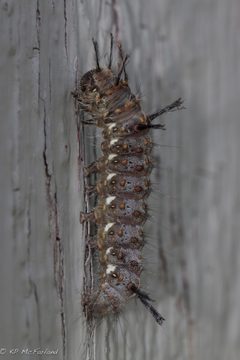
Panthea furcilla is a noctuid occurring across Canada and the eastern United States. fly from June to August, with a single in Canada and multiple generations in the southern United States. The is notable for its association with coniferous trees, with larvae feeding on pines, spruces, and eastern larch. Two are recognized: the nominate P. f. furcilla and the southern P. f. australis.
Pronunciation
How to pronounce Panthea furcilla: //ˈpænθiə fɜːrˈsɪlə//
These audio files are automatically generated. While they are not always 100% accurate, they are a good starting point.
Identification
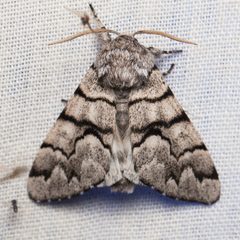
Distinguished from similar Panthea by geographic range and association. P. furcilla overlaps with P. acronyctoides in some areas, but of P. furcilla tend to have more contrasting forewing patterning. The southern P. f. australis was described in 2009 based on subtle morphological differences. The supposed species P. pallescens is now considered a color form of P. furcilla with no taxonomic standing.
Images
Appearance
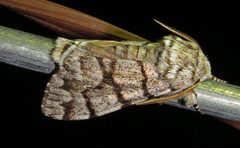
have a wingspan of 33–50 mm. The forewings are typically grayish-brown with darker markings and a somewhat tufted or furry appearance, particularly on the . The hindwings are pale with darker margins. The overall coloration provides cryptic camouflage against bark.
Habitat
Associated with coniferous forests, particularly stands of pine, spruce, and larch. Occurs in forest regions and eastern deciduous forest zones where conifers are present. Found in both mature forest stands and areas with younger conifer growth.
Distribution
forest region of Canada west to the Rocky Mountains; eastern United States from Maine south to Florida, west to Texas, and north to Indiana and Ohio. The P. f. australis occurs in the southern portion of the range.
Seasonality
fly from June to August. Single in Canada; two or more in the southern United States depending on location.
Diet
Larvae feed on eastern larch (Larix laricina), pines (Pinus spp.), and spruces (Picea spp.). feeding habits are not documented.
Host Associations
- Larix laricina - larval foodplanteastern larch
- Pinus spp. - larval foodplantpines
- Picea spp. - larval foodplantspruces
Life Cycle
Complete with , larval, pupal, and stages. Larvae are the active feeding stage on conifer foliage. stage not explicitly documented in sources.
Behavior
are and attracted to ultraviolet light. Larvae are solitary feeders on conifer needles.
Ecological Role
Larval herbivore on coniferous trees; contributes to nutrient cycling in forest . levels typically remain below economically damaging thresholds.
Human Relevance
Occasionally encountered by foresters and entomologists in coniferous stands. Not considered a significant forest pest. occasionally attracted to blacklights and UV lights used for insect surveys.
Similar Taxa
- Panthea acronyctoidesOverlapping range but generally with less contrasting forewing pattern; subtle differences in genitalia
Misconceptions
The name P. pallescens was formerly applied to a pale-colored form, but this is now recognized as simply a color variant of P. furcilla without taxonomic validity.
More Details
Subspecies
Two recognized: Panthea furcilla furcilla (Packard, 1864) across most of the range, and Panthea furcilla australis Anweiler, 2009 in the southern United States. The latter was described based on specimens from the southern Appalachians and Gulf Coast region.