
Panthea acronyctoides
Walker, 1861
Black Zigzag, Tufted Spruce Caterpillar, Black Zigzag Moth
A medium-sized noctuid found across northern North America, with two recognized . fly from May to August and are attracted to light. Larvae feed on coniferous trees, particularly spruces and firs, and are known as the 'tufted spruce caterpillar' due to their distinctive appearance.
Pronunciation
How to pronounce Panthea acronyctoides: /ˈpænθiə əˌkrɒnɪkˈtɔɪdiːz/
These audio files are automatically generated. While they are not always 100% accurate, they are a good starting point.
Identification
The black zigzag forewing pattern distinguishes from other Panthea . The P. a. nigra (described 2009) is darker and requires examination of genitalia for definitive identification. Larvae are distinguished from other conifer-feeding caterpillars by their tufted appearance and association.
Images
Appearance
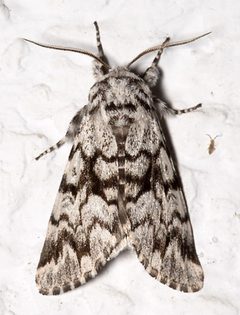
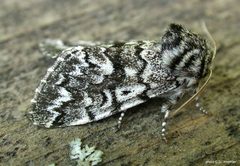
have a wingspan of 30–35 mm. The forewings display a distinctive black zigzag pattern against a lighter background, giving the its . The P. a. nigra is darker overall. Larvae are characterized by tufts of hair-like setae, which contribute to the 'tufted' common name.
Habitat
Associated with coniferous forests, particularly those containing spruce, fir, hemlock, larch, and pine. Larval is the foliage of trees; are found in forested areas and are attracted to artificial light sources.
Distribution
North America from Newfoundland to British Columbia, south in the west to Colorado, and south in the east to New England and Kentucky. Records from Alberta, Manitoba, and Saskatchewan in Canada; Vermont and adjacent northern states in the USA.
Seasonality
fly from May to August, with timing varying by latitude and elevation. The period is generally earlier in southern portions of the range and later in northern areas.
Diet
Larvae feed on balsam fir (Abies balsamea), eastern hemlock (Tsuga canadensis), eastern larch (Larix laricina), various pines (Pinus spp.), and spruces (Picea spp.). feeding habits are not documented.
Host Associations
- Abies balsamea - larval food plantbalsam fir
- Tsuga canadensis - larval food planteastern hemlock
- Larix laricina - larval food planteastern larch
- Pinus spp. - larval food plantpines
- Picea spp. - larval food plantspruces
Life Cycle
Complete with , larval, pupal, and stages. Larvae are the 'tufted spruce caterpillar' stage. Specific details of site and stage are not documented in available sources.
Behavior
are and attracted to light. Larvae feed externally on conifer needles. No other specific are documented.
Ecological Role
Larvae function as folivores on coniferous trees, potentially contributing to defoliation events. Their role in forest as prey for birds and other is likely but not specifically documented.
Human Relevance
Larvae are occasionally referred to as 'caterpillars' in forestry contexts but are not documented as significant economic pests. The is of interest to lepidopterists and is regularly encountered at light traps in forested areas.
Similar Taxa
- Panthea furcillaSimilar size and (coniferous forests), but lacks the distinctive black zigzag forewing pattern and has different larval preferences (white pine)
- Other Panthea species members share general but differ in forewing pattern, coloration, and geographic distribution
More Details
Subspecies
Two are recognized: P. a. acronyctoides (nominate, described 1861) and P. a. nigra (described by Anweiler 2009). The latter is darker and was described based on specimens from western Canada.
Nomenclature
Originally described by Francis Walker in 1861 as Audela acronyctoides, later transferred to Panthea. The basionym is Audela acronyctoides.