
Cosmia
Ochsenheimer, 1816
pinion moths
Species Guides
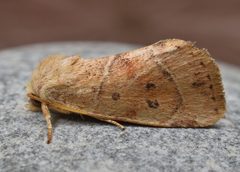
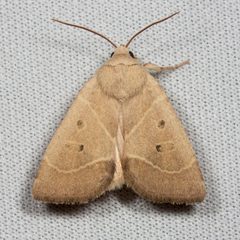
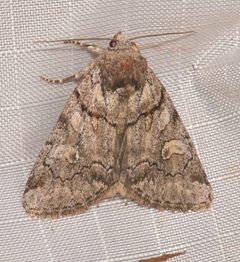
3- Cosmia calami(American Dun-bar Moth)
- Cosmia elisae(cutworm moth)
- Cosmia praeacuta(cutworm moth)
Cosmia is a of noctuid comprising approximately 35 described distributed across the Palaearctic region. The genus includes notable species such as the dun-bar (C. trapezina), lunar-spotted pinion (C. pyralina), and white-spotted pinion (C. diffinis). Several species are associated with elm trees, and at least one species (C. pyralina) has experienced decline in Britain linked to affecting its plants. The of C. pyralina has been sequenced, revealing a 803.3 Mb assembly with 31 chromosomal pseudomolecules.
Pronunciation
How to pronounce Cosmia: /ˈkɒz.mi.ə/
These audio files are automatically generated. While they are not always 100% accurate, they are a good starting point.
Identification
within Cosmia can be challenging to distinguish. Cosmia pyralina (lunar-spotted pinion) differs from the similar C. affinis (lesser-spotted pinion) by its paler hindwings and broader forewings. C. pyralina exhibits variable colour morphs ranging from dull to bright red-brown forewings. Wingspan of C. pyralina measures 28–32 mm. Accurate identification often requires examination of genitalia or molecular markers.
Images
Habitat
Deciduous woodlands, particularly those containing elm (Ulmus spp.), blackthorn (Prunus spinosa), and hawthorn (Crataegus monogyna). Cosmia diffinis has been documented specifically on Ulmus minor in European Turkey.
Distribution
Central Europe through the Palaearctic to Korea and Japan. In Britain, C. pyralina occurs in central and southern England and more scarcely in Wales, particularly the south-east. Cosmia diffinis has been recorded from Edirne Province, European Turkey.
Diet
Larvae are on deciduous trees. Documented plants for C. pyralina include blackthorn (Prunus spinosa), hawthorn (Crataegus monogyna), English elm (Ulmus procera), and wych elm (Ulmus glabra). Cosmia diffinis is associated with Ulmus minor.
Host Associations
- Prunus spinosa - larval food plantC. pyralina
- Crataegus monogyna - larval food plantC. pyralina
- Ulmus procera - larval food plantC. pyralina
- Ulmus glabra - larval food plantC. pyralina
- Ulmus minor - larval food plantC. diffinis
Ecological Role
Herbivore on deciduous trees. Cosmia diffinis serves as for . of at least one (C. pyralina) are linked to tree affecting host plants.
Human Relevance
C. pyralina has been the subject of sequencing research. decline of C. pyralina in Britain has been documented, likely due to caused by Ophiostoma novo-ulmi affecting its elm trees.
Similar Taxa
- Cosmia affinisSimilar appearance to C. pyralina; distinguished by darker hindwings and narrower forewings
More Details
Genome sequencing
The of Cosmia pyralina has been sequenced, with an assembly size of 803.3 Mb, 31 chromosomal pseudomolecules (30 + Z ), and 19,901 protein-coding genes. Specimen was collected from Wytham Woods, Oxfordshire, UK.
Species diversity
The contains approximately 35 described , with representatives across Europe, Asia, and Africa.
Sources and further reading
- BugGuide
- Wikipedia
- iNaturalist taxon
- NCBI Taxonomy
- Catalogue of Life
- The Parasitoid Complex of White-spotted Pinion Cosmia diffinis (Linnaeus, 1767) (Lepidoptera: Noctuidae) on Ulmus minor Miller (Ulmaceae) in Edirne Province (European Turkey)
- The genome sequence of the Lunar-spotted Pinion, Cosmia pyralina (Denis & Schiffermüller, 1775).