
Eurois occulta
Linnaeus, 1758
Great Brocade, Great Gray Dart
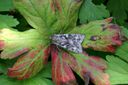
Eurois occulta, commonly known as the Great Brocade or Great Gray Dart, is a medium-sized noctuid with a Holarctic distribution spanning northern Europe, Asia, and North America. display distinctive gray forewings with bold black-and-white patterning and a wingspan of 50–60 mm. The exhibits notable color , including a nearly black mountain form (f. implicata) found in Finland, Germany, and Scotland. Larvae feed on various woody and herbaceous plants including Vaccinium, birch, and willow.


Pronunciation
How to pronounce Eurois occulta: /ˈjuːroʊɪs ɒkˈkʌltə/
These audio files are automatically generated. While they are not always 100% accurate, they are a good starting point.
Identification
Distinguished from similar noctuids by the combination of large gray stigmata with black outlines, the black basal streak below the , and the striking black-and-white toothed submarginal line. The pale gray ground color with dark suffusion and white-filled transverse lines further separate it from . The dark mountain form implicata may be confused with other dark noctuids but retains the characteristic pattern elements.
Images
Appearance
Wingspan 50–60 mm. Forewing pale gray, variably suffused with darker gray; black streak extends from wing base below ; stigmata large and gray with black outlines, cell area dark. Inner and outer transverse lines filled with whitish. Submarginal line composed of prominent alternating black and white teeth. Hindwing fuscous with white fringe.
Habitat
Northern and montane regions; found in forests, subarctic tundra, and upland moorlands. The dark form implicata is specifically associated with mountain .
Distribution
Holarctic: northern and central Europe, North Asia and central Asia east to the Pacific Ocean and Japan. North America: coast to coast across Canada, south to Virginia and Great Lakes states in the east. Also recorded from Greenland, Iceland, northern Spain, and the Balkan peninsula.
Diet
Larvae feed on Myrica gale, Vaccinium , birch (Betula), willow (Salix), and various other herbaceous plants.
Host Associations
- Myrica gale - larval food plant
- Vaccinium - larval food plant
- Betula - larval food plantbirch
- Salix - larval food plantwillow
Life Cycle
Larva brown with darker mottling; and lines yellowish, spiracular line white; series of oblique lateral dark stripes. occurs in soil or substrate.
Human Relevance
Historical research has suggested, based on pupal remains in peat deposits at Anavik, that of this may have contributed to the collapse of Norse settlements in Greenland. These deposits have since dried out, eliminating potential for further study.
Similar Taxa
- Other Eurois speciesSimilar noctuid build and patterning; distinguished by specific wing pattern elements of E. occulta including the black basal streak and toothed submarginal line
- Dark noctuid species in montane habitatsForm implicata may resemble other dark ; requires examination of pattern details for confirmation
More Details
Historical significance
Pupal remains in Greenland peat deposits have been tentatively linked to Norse settlement collapse, though this hypothesis cannot be further tested due to desiccation of the Anavik site.
Color polymorphism
The exhibits clinal variation in coloration, with darker forms associated with higher elevations and latitudes.