
Anaplectoides prasina
(Denis & Schiffermüller, 1775)
Green Arches
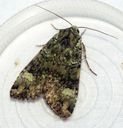
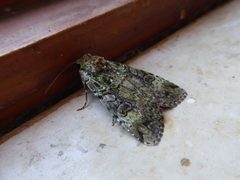
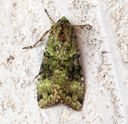
A medium-sized noctuid with distinctive green forewings marked by dark green or blackish patterning. The exhibits notable color , with forms ranging from pale whitish-green to dark brownish-grey. are active from May to August across a broad Holarctic distribution. Larvae are broad feeders on both herbaceous plants and hardwood trees.
Pronunciation
How to pronounce Anaplectoides prasina: /ˌænəˌplɛkˈtɔɪdiːz ˈpræsɪnə/
These audio files are automatically generated. While they are not always 100% accurate, they are a good starting point.
Identification
Distinguished from similar noctuids by the combination of green forewing ground color, the characteristic pale blotch between stigma and outer line, and black-edged dark green stigmata. The polymorphic forms can be confused with other : ab. pallida resembles pale noctuids but retains the distinctive pattern elements; ab. suffusa may resemble brown noctuids but usually shows traces of the typical pattern; ab. lugubris is most easily confused with other grey noctuids but may show residual greenish tones. The hindwing is uniformly fuscous without strong patterning, which helps separate it from some related .
Images
Appearance
Wingspan 40–50 mm. Forewings green, variably tinged with dark green or blackish; a green-tinged cream or whitish blotch present between the stigma and outer line; stigmata dark green with black edges; inner and outer lines black, conversely edged with white, whitish-green, or concolorous. Hindwing fuscous with paler fringe. Color well-documented: ab. pallida is an extreme pale whitish-green form; ab. suffusa is a rare red-brown form with blackish stigmatal area; ab. albimacula has grey ground color with clear white or grey-filled patch beyond reniform; ab. lugubris is dark brownish-grey with reduced green or white markings. Larva purplish brown with pale line intersecting blackish dorsal blotches; spiracular line pale with dark upper edge.
Distribution
Europe eastward through Siberia, Central Asia, Mongolia, China, Tibet, Korea, and Japan; also Armenia and the Caucasus. In North America: southern Canada, Washington, Oregon, northern Utah, New Mexico, New Jersey, Ohio, and North Carolina.
Seasonality
fly from May to August, with timing varying by location.
Diet
Larvae are broad feeders, consuming both herbaceous plants and hardwood trees. Documented plants include blueberries (Vaccinium), hazelnut (Corylus), maples (Acer), and raspberry (Rubus).
Life Cycle
Complete with documented larval stage purplish brown with pale line and blackish dorsal blotches. period May–August. Specific details of , pupal stages, and strategy not documented in available sources.
Similar Taxa
- Anaplectoides pressusSimilar congeneric ; differentiation requires examination of genitalia and precise pattern details
- Other green Noctuidae (e.g., some Dichonia, Earias)Similar green coloration but differ in wing pattern details, particularly the presence and position of the pale blotch between and outer line