
Euxoa declarata
Walker, 1865
clear dart
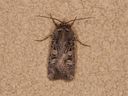
Euxoa declarata is a noctuid commonly known as the clear dart. have a wingspan of 31–37 mm and are active from July to September with one per year. The is notable for its reproductive isolation from closely related species (E. campestris and E. rockburnei), which is maintained primarily through differences in circadian mating rhythms rather than differences. Males of all three species respond to the same synthetic attractants. The species belongs to the 'declarata group' of Euxoa, a complex of interfertile that remain reproductively isolated in nature through temporal partitioning of mating activity.
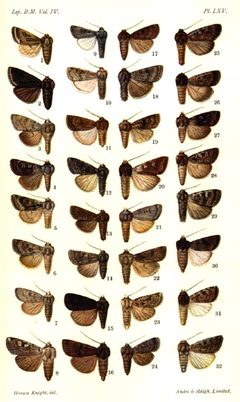
Pronunciation
How to pronounce Euxoa declarata: /juːkˈsoʊ.ə dɪˈklær.ə.tə/
These audio files are automatically generated. While they are not always 100% accurate, they are a good starting point.
Identification
Wingspan 31–37 mm. Distinguished from E. campestris and E. rockburnei by differences in female calling posture at 20°C (becomes indistinguishable at lower temperatures). Most reliably separated from by temporal activity patterns rather than morphological features.
Images
Habitat
preferences appear to differ slightly from closely related E. campestris and E. rockburnei, contributing to reproductive isolation in nature. Specific habitat details not documented in available sources.
Distribution
Canada: Ontario, Quebec, New Brunswick, Nova Scotia, Prince Edward Island, British Columbia, Alberta, Saskatchewan, Yukon, Manitoba. United States: Minnesota, North Carolina, Arizona, New Mexico, California. Western limit: central Alaska.
Seasonality
active July to September. One per year.
Behavior
. Female calling ( release) occurs during scotophase, with timing temperature-dependent—calling occurs progressively earlier as temperature decreases from 20°C to 5°C. At 20°C, exhibits distinct calling posture compared to ; posture becomes indistinguishable at lower temperatures. Reproductive isolation from E. campestris and E. rockburnei maintained primarily through -specific of mating activity.
Similar Taxa
- Euxoa campestris in the declarata group; interfertile but reproductively isolated in nature by temporal partitioning of mating activity. No cross-attractancy under natural , though cross-attraction can be induced by photoperiod manipulation.
- Euxoa rockburnei in the declarata group; parapatric distribution with some cross-attractancy to E. campestris but not to E. declarata under natural conditions. Reproductive isolation maintained primarily by differences in mating rhythms.
Sources and further reading
- BugGuide
- Wikipedia
- GBIF taxonomy match
- iNaturalist taxon
- NCBI Taxonomy
- Catalogue of Life
- Aboveground Pests - AgriLife Extension Entomology
- Stem- and Leaf- Feeding Insects - AgriLife Extension Entomology
- Bug Eric: Winter 'pillars
- How Army Cutworm Moths Bounce Between Midwest Heat and Alpine Cool
- Bug Eric: My Kind of Fourth of July
- Bug Eric: July 2019
- Biosystematics of the genus Euxoa (Lepidoptera: Noctuidae). XI. Mating discrimination between three closely related species of the declarata group
- BIOSYSTEMATICS OF THE GENUS EUXOA (LEPIDOPTERA: NOCTUIDAE) XV. SEX PHEROMONE CROSS ATTRACTANCY AMONG THE THREE CLOSELY RELATED SPECIES OF THE DECLARATA GROUP
- BIOSYSTEMATICS OF THE GENUS EUXOA (LEPIDOPTERA: NOCTUIDAE): XIV. EFFECT OF TEMPERATURE ON FEMALE CALLING BEHAVIOR AND TEMPORAL PARTITIONING IN THREE SIBLING SPECIES OF THE DECLARATA GROUP