
Agrotis venerabilis
Walker, 1857
dusky cutworm, Venerable Dart
Agrotis venerabilis, commonly known as the dusky or Venerable Dart, is a noctuid first described by Francis Walker in 1857. The species has a broad transcontinental distribution across North America, ranging from central Canada to Mexico. are active from August to September in temperate regions, with an extended season in the Neotropics beginning as early as March. The larvae are agricultural pests known as cutworms that feed on a variety of cultivated crops and weeds.
Pronunciation
How to pronounce Agrotis venerabilis: /əˈɡroʊtɪs vɛˈnɛrəˌbaɪlɪs/
These audio files are automatically generated. While they are not always 100% accurate, they are a good starting point.
Identification
can be distinguished from similar Agrotis by the combination of wingspan (approximately 37 mm), dull grayish-brown forewing coloration with variable darker markings, and the specific geographic and seasonal occurrence patterns. The species is most reliably identified by genitalia examination or molecular methods. Larvae are identified by their —curling into a C-shape when disturbed—combined with plant associations and geographic location. Separation from other Agrotis cutworms requires rearing to adults or expert larval identification.
Images
Appearance
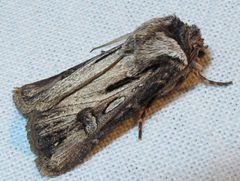
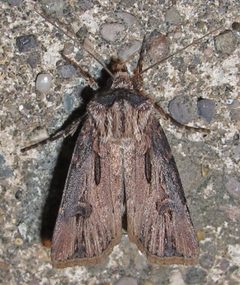
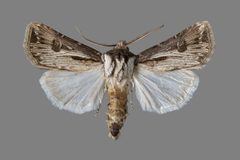
have a wingspan of approximately 37 mm. The forewings are typically dull grayish-brown with variable darker markings, consistent with the 'dusky' . The hindwings are pale, likely whitish or grayish. Larvae are plump, smooth-bodied caterpillars that curl into a C-shape when disturbed, typical of cutworms in the Agrotis. Larval coloration varies from grayish-white to grayish-black or brown.
Habitat
Found in a variety of open including agricultural fields, grasslands, and weedy areas. The thrives in cultivated landscapes where plants are abundant. prefer to lay in grassy and weedy fields, with larvae developing in soil or among plant debris.
Distribution
Transcontinental across North America, from coast to coast. Documented from central Canada (Alberta, Manitoba, Saskatchewan) south through the United States to Mexico. Vermont records confirm eastern North American presence. The occupies temperate and subtropical zones within this range.
Seasonality
are on wing from August to September in temperate climates. In the Neotropics, the season begins at least as early as March and extends more broadly through the year. Larval activity occurs primarily in spring and early summer, with in soil during early summer.
Diet
Larvae feed on a documented range of plants including Medicago sativa (alfalfa), Trifolium (clover), Nicotiana tabacum (tobacco), Viola (violets), Stellaria media (common chickweed), Avena sativa (oats), and Zea mays (corn). The is a feeder on herbaceous plants with a preference for agricultural crops and associated weeds.
Life Cycle
are laid in soil or on stems and leaves of plants, hatching in 2 to 14 days. Larvae feed nocturnally, remaining underground during daylight hours. They feed on soil surface or aboveground plant parts, cutting plants at, slightly below, or above the soil surface. Fully grown larvae reach 1 to 2 inches in length. occurs in soil in early summer. Some individuals may overwinter as small larvae in grass clumps or soil under debris, though the primary stage is not definitively established for this .
Behavior
are . Larvae exhibit typical : nocturnal feeding, concealment in soil or debris, and defensive curling into a C-shape when disturbed. Larvae are surface feeders that sever plant stems, causing characteristic 'cut' plant damage.
Ecological Role
As a herbivore, larvae function as primary consumers in agricultural and grassland . The serves as prey for various including birds, ground beetles, and . As a crop pest, it influences agricultural management practices and plant composition in cultivated areas.
Human Relevance
Significant agricultural pest. Larvae damage alfalfa, corn, oats, tobacco, and other crops by cutting seedlings at or below the soil surface, reducing plant stands and yield. Management includes cultural controls (weed destruction, proper seedbed preparation, timing of planting) and chemical applied as broadcast treatments, banded applications at planting, or foliar sprays. Insecticide application timing is optimized for late afternoon when cutworms are near the surface.
Similar Taxa
- Agrotis ipsilonBlack cutworm, also a widespread agricultural pest with similar larval and damage . differ in wing pattern and size; larvae require rearing or expert identification to distinguish.
- Agrotis orthogoniaPale western cutworm, a subterranean feeder with different feeding (feeds on crown stems below soil surface). Distinguished by preference for loose, sandy soils and different damage .
- Euxoa speciesRelated noctuid cutworms with similar and . Separation requires examination of genitalia or detailed larval characteristics.
More Details
Subspecies
Two are recognized: Agrotis venerabilis venerabilis (nominate form) and Agrotis venerabilis arida.
Management considerations
Cultural control methods are emphasized for this : destroying weeds, preparing seedbeds 4 to 6 weeks before planting, and reducing weed cover in late summer or fall. damage is more severe in weedy fields. efficacy is improved by late afternoon application when larvae are active near the soil surface.
Sources and further reading
- BugGuide
- Wikipedia
- GBIF taxonomy match
- iNaturalist taxon
- NCBI Taxonomy
- Catalogue of Life
- Congrats to Antoine Abrieux, Innovator Fellow Award | Bug Squad
- Occasional Pests - AgriLife Extension Entomology
- Encyrtid Holdings | Entomology Research Museum
- Stem- and Leaf- Feeding Insects - AgriLife Extension Entomology
- Antoine Brieux to Share PPTM Research on Fruit Fly | Bug Squad
- Insect-resistant Maize Could Increase Yields and Decrease Pesticide Use in Mexico